
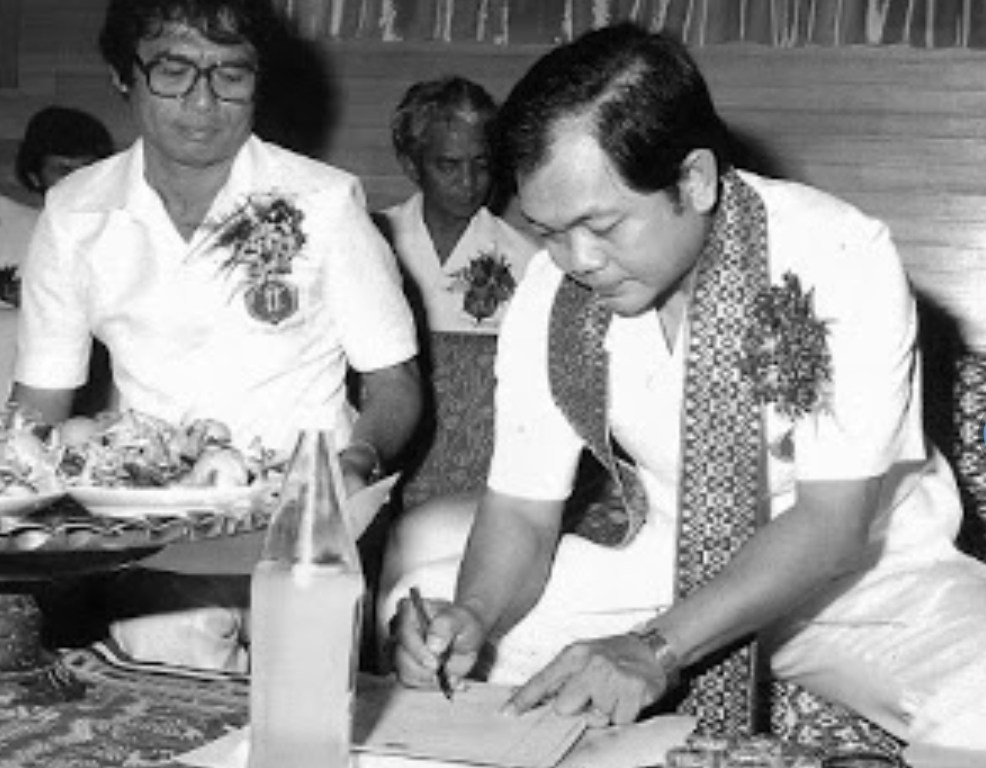
This political crisis already started brewing when Rahman Ya’kub was the governor of Sarawak. He criticised his nephew in a speech at a ceremony of opening of Bintulu port in 1983. In 1985, Rahman Ya’kub was involved in a bitter dispute with his nephew, Abdul Taib Mahmud over allocation rights. In 1987, Rahman Ya’kub formed a new party named Parti Persatuan Rakyat Malaysia Sarawak (PERMAS) in order to challenge Taib Mahmud at the polls. He also formed an alliance with Sarawak Dayak People’s Party (PBDS) in order to unseat Taib Mahmud. In March 1987, 27 of the 48 state assemblymen suddenly directed their support to Rahman Ya’kub while calling Taib Mahmud to resign as a chief minister. Among the defectors were Taib’s 4 cabinet ministers and 3 assistant ministers. A war of accusations on timber concessionaires then broke out between Rahman Ya’kub and Taib Mahmud. Taib Mahmud revoked 30 timber licenses held by his defectors and Rahman’s clients. Taib then accused Rahman for awarding 1.25 million hectares of logging concessions worth RM 22.5 billion to Rahman himself and his relatives. Rahman Ya’kub, in return, revealed a list of timber concessions covering 1.6 million hectares held by Taib’s clients and family. Despite the unsuccessful attempt at the 1987 Sarawak state election, Rahman continued his struggle with his allies, Sarawak Dayak People’s Party against Taib’s led Sarawak Barisan Nasional until 1991 Sarawak state election when Taib’s coalition won an overwhelming majority of 49 out of 56 seats in the state assembly.
The Ming Court is a hotel in Kuala Lumpur, where a group of politicians headed by the former Governor of Sarawak, Tun Abdul Rahman Yakub gathered sometime in March 1987 and discussed a plan to topple the State government of Sarawak under the leadership of Taib Mahmud, Rahman’s nephew. The Ming Court Hotel became the “headquarters” of these politicians who were dissatisfied with Taib’s government. Thus, the name of Ming Court Hotel Affair came about.
Dissatisfaction with Taib’s leadership started as early as in 1985, when Bumiputera politicians accused him of neglecting the interests of Bumiputeras – the Malays, Ibans and Bidayuhs and giving so much face to the Chinese. Many big projects, timber concession areas and large tracts of land were given to the Chinese and SUPP. Because of a special relationship between Taib and SUPP leaders, SUPP became very daring in its demand. SUPP even asked the State government to give it a piece of land in each of the seven divisions in the State for the construction of its premises. This request by SUPP angered the Bumiputeras Wilfred Nissom, the independent State Assemblyman for Bengoh, was among those who were critical of Taib Mahmud. Nissom accused Taib of being a “weak” Chief Minister who always gave in to demands by SUPP. He said that it was only a weak Chief Minister who tried to make a criminal out of a Bidayuh who had made a private application to join PBB under him.
No grasp of recent Sarawak political history can be said to be firm without an understanding of the Ming Court Affair, the pivotal event of the last two decades, the fallout from which is felt to this day as the state gears up for the PRU14. Essentially there were four main actors in the drama, not all of whom were present at the eponymous hotel in Jalan Ampang in Kuala Lumpur where simmering discontent with the leadership of Taib Mahmud came to a head in a plot to remove him as Chief Minister in early March 1987.The major players were the then eminence grise of Sarawak politics, Rahman Yaakub; the man who would be king, Taib Mahmud; the man who had aspirations to be chief minister, Leo Moggie; and the affair’s late joining but main casualty, Daniel Tajem.
By March 1987, Taib, post-merger-with-the-Federation of Malaysia’s fourth chief minister of Sarawak, was six years in the post, and already the object of deep disaffection in the ruling state Barisan Nasional (BN) coalition, not only among Sarawak National Party (Snap) stalwarts like James Wong Kim Min and Edward Jeli but also among his own Parti Bumiputera Bersatu (PBB) bigwigs like Noor Tahir, Salleh Jafaruddin and Wan Yusof. Discontent with Taib was also felt by another state coalition partner, Parti Bansa Dayak Sarawak (PBDS), but it was of a vague sort, having more to do with general Dayak unhappiness that the chief minister’s post had not been in the hands of one of them for 17 years. The main factor for upheaval in the relationship between PBDS and Taib Mahmud was Taib’s perception that Leo Moggie, the PBDS president with the federal cabinet portfolio of energy, post and telecommunications, was seen as growing close to the then prime minister Dr Mahathir Mohamad, the federal BN supremo whose panache at balancing contending forces in his disparate coalition by manipulating their antagonism was matchless. As Moggie’s ingratiation with Mahathir continued to cause unease in Taib, the latter gave subtle hints to deputy chief minister Tajem, Moggie’s deputy in PBDS, he ought to move up a notch in the party. Tajem did nothing to endear himself by resisting Taib’s blandishments.
Twenty one years before, Kuala Lumpur had also been the focal point of a cabal out to oust Snap’s Stephen Kalong Ningkan as chief minister. Perhaps the most potent factor in the immediate prelude to the Ming Court gathering was James Wong’s exasperation at Taib’s tardiness in renewing logging licences the Snap titan had to 60,000 acres of mangrove timber and 100,000 acres of hill timber in Limbang. This exasperation saw Snap’s state assembly and federal parliamentary representatives joining the disaffected from PBB and PBDS to plot the ouster of Taib, leaving only SUPP grandees conspicuous by their absence. By the end of the first week of March 1987, it only remained for Daniel Tajem to join the cabal to raise the incipient mutiny to an unbridled rebellion. As the motley bunch of anti-Taib rebels gathered in Ming Court, Deputy Chief Minister Tajem, who was in charge of agriculture and community development, was in Mukah for a farmers’ organization function. He officiated and flew back to Kuching the next morning, a Saturday, growlingly aware of ominous murmurings of mutiny in KL. On arrival at his two-acre home in Jalan Urat Mata in Kuching, he hovered by the fish pond in the sprawling garden, more intent on his eldest son’s 17th birthday party that evening than on mutinous goings-on in KL. Tajem’s reverie was interrupted by a call from Liap Kudu, Leo Moggie’s principal private secretary. Kudu said party chief Moggie wanted Tajem to fly out to KL soonest. Tajem said he would see Leo after the federal-level BN pre-council meeting, to be chaired by Deputy Prime Minister Ghafar Baba, scheduled for Sunday afternoon in Parliament.
Tajem had been elected PBDS MP for Batang Lupar the previous year (1986), besides being the state assembly representative for Bukit Begunan. In the event, Ghafar’s meeting lasted a mere 30 minutes. Tajem instructed George Entigar, his secretary, to book him at the Shangri-La Hotel while the Rumah Sarawak chauffeur drove him on to Ming Court where, in the coffeehouse, Moggie was huddled with Edmund Langgu, the PBDS MP and federal deputy minister. “Tun Rahman wants to see you at his home,” was all that Moggie said to him. Tajem proceeded to Jalan U Thant, an upper-class suburb in KL where in the hall of Rahman’s bungalow he could see Edward Jeli, Wan Yusof and Salleh Jafaruddin standing in conspiratorial knots. From an adjoining room wafted the voice of Noor Tahir, soon to be an important element in the plot that was racing to a denouement. Upstairs, a waiting Rahman told Tajem a majority of the state assembly’s 48 members had agreed to sign a petition to the governor that they no longer had any confidence in Taib as CM and that they wanted a new man in the post. Tajem demurred, arguing that the procedure was improper. He said he had helped draft the state assembly’s Standing Orders a few years before and that, based on his understanding of the rules, it would be better to petition the Speaker for a special sitting where a resolution expressing no confidence in Taib could be tabled.
Tajem had known Rahman since 1960 when the then deputy public prosecutor had given lectures on law to the former who was a trainee in the Sarawak Administrative Service. Rahman, who early on had developed an eye for spotting ability in his wards, had sponsored Tajem’s application for a British passport when the latter prepared to go to New Zealand in 1962 for law studies. At that time only a Division One officer, which Rahman was by dint of his DPP status, could sponsor passport applications. But those early days of ease in the relationship were replaced by wariness when Tajem, elected to the state assembly in 1974 on an opposition Snap ticket, was at odds with Chief Minister Rahman on a host of issues. Rahman, on becoming CM in 1970, had invited Tajem to join the government but the latter declined to leave private practice. However, in 1980, four years after Snap joined the state BN coalition, Tajem joined Rahman’s cabinet. A shrewd Rahman knew that against some adversaries co-optation was better than preemption.
While Rahman and Tajem were arguing the finer points of procedure on how best to oust Taib, Tajem could hear the clatter of a typewriter from an adjoining room. Presently, a man appeared from inside whom Tajem recognised as a lawyer, a Chan by name. Tajem reiterated his reservations about the ousting procedure. From the scads of conversation with both Rahman and Chan, Tajem gathered that Noor Tahir, a PBB assemblyman, had been detailed to forward the petition with a probable 30-plus signatures to Governor Zaidi. As the exchange between Rahman and Tajem tapered off, the former slipped him a brown envelope, saying Tajem should use its contents for party expenses and could expect more. A by-now discontented Tajem asked Adam, the Rumah Sarawak chauffeur, to drive him back to the Shangri- La. On the way, he discovered the envelope given him by Rahman contained three hundred RM100 dollar bills. He gave the envelope to Paul Kadang whom he met as he arrived at the Shangri- La. Tajem told Kadang, the PBDS executive secretary, to use the money for expenses incurred by the PBDS headquarters.
The notion that a night’s sequestration from the swirling anti-Taib Mahmud currents would bring reprieve – and, more importantly – perspective, was rudely dispelled on Monday morning when personal secretary George Entigar informed Daniel Tajem over breakfast that Abdul Rahman Hamzah had wanted his signature the previous night on a letter of resignation as deputy chief minister. Worse followed. News arrived from Kuching that the morning’s Sarawak Tribune (now defunct) had trumpeted Tajem’s resignation as DCM.
Tajem now felt like a canoeist paddling on both sides to keep from capsizing in the rapids. He evaded a TV3 reporter hot on his trail, went to Parliament in the afternoon, could not concentrate on the proceedings, ducked out, told Entigar to check him out of the Shangri-La Hotel, and got chauffeur Adam to drive him to Ming Court where he booked a room as more members of the cabal to oust Taib began streaming in. The lounge and coffeehouse were a welter of conspiracy. He continued to be ambivalent about the whole question of ousting Taib. His views on a host of issues in Sarawak politics and his feelings about Taib and other top politicians in the state had not yet crystallised, understandable given that the overall political culture enabled platitudinous public utterance to hide ulterior venal intention. In March 1987, Tajem had completed five years as DCM, in charge of agriculture and community development, a portfolio with high impact on the Dayak community, particularly his fellow Iban who were not only the majority ethnic group among the Dayaks, but were also the largest of all races in the state (the Chinese, conceding two percentage points, were second at 26%).
The Dayaks were mainly farmers, planting rice, rubber, oil palm and pepper, on land held under Native Customary Rights (NCR). They lived in longhouses close by rivers – the Iban mainly in the upper reaches of the mighty Rejang – that wend their way from the mountain fastness of neighbouring Kalimantan to the continental shelf in the South China Sea. Fish and prawn the Dayaks obtained from the rivers and meat came mainly from boar roaming the jungle-clad hills. In rudiment this existence can spawn Rousseau-like visions of the noble savage among idle theorists. In reality, Dayak life in the longhouses in the deepest interior, if not nasty, was often brutish and short. Tajem, born in hardscrabble conditions in a longhouse near Kuching in 1937, was among the first Dayaks to escape the poverty trap through education and emerged in post-merger (with the Federation of Malaysia in 1963) Sarawak as one of the first lawyers from the community.
As agriculture minister his priority was not to put more food on the Dayak farmer’s table, essentially the thrust of Dr Wong Soon Kai, his SUPP predecessor in the ministry, who viewed well-fed Dayaks as satisfied with being cheap labour for Foochow-owned construction sites and industries in the state. Tajem’s purpose was to put more income into the Dayak tiller’s pocket so that he could afford to send his children to better residential schools in the major towns, a surer way out of the poverty trap of the longhouse.
When he discovered that only 30% of the government’s fertiliser subsidy reached the end-user, he tried to alter that reality, coupling it with encouragement for the farmer to use better methods for higher yields and income. He pressed for higher allocations for agriculture from the annual budget but in vain. The SUPP-controlled finance portfolio in the ruling coalition and CM Taib’s focus on forestry meant that his requests were not priority. Even simple matters like requisitions for the use of a helicopter for visits to the interior where farmers resided were not easily granted. It appeared the powers-that-be wanted his stewardship of Dayak aspirations to meet the forms and not the substance of representation.
But for the navigation of shoals requiring delicacy and a dollop of courage, he was point man of first choice. As when it became necessary to tell former CM Rahman, at one time while he was governor (1981-86), which his publicly expressed unhappiness with the 5% royalty to the state from the federal government from revenue garnered by the Liquefied Natural Gas project in Bintulu was roiling federal-state relations. Tajem led the delegation, with Taib in tow, to appeal to Rahman to pipe down. When that mission did not quite succeed in achieving its goal, Tajem was again the leader of a delegation to see Prime Minister Dr Mahathir Mohamad to assuage federal disquiet over Rahman’s public indelicacies.
To be sure, towards the end of his tenure as chief minister (1970-81), Rahman had asked lawyer Tajem to examine the issue of state rights with respect to royalties on offshore deposits of oil and gas and how the international protocols concerning the issue of such finds in the continental shelf, to which Sarawak accessed before joining Malaysia in 1963, may provide a way round the federal stipulation that royalties would be higher than 5% only for deposits found within three nautical miles off the coast. The huge gas deposits off Bintulu lay beyond that range. The revenue from the find at one stage was reported to have provided a third of the annual federal budget. Rahman, a Sarawak-first man, felt that if the 5% limit on LNG royalty was inflexible, the federal government should pour more money into development of the Bintulu hinterland. Mahathir, never solicitous of state rights, was impervious to what’s taken out should be funneled-back argument. Observing at close quarters, the tug of these conflicting imperatives provided Tajem invaluable insight into the complexities of government. But he realised that complexities should not be allowed to perplex and sever the nerve of action. Politicians have to act even when all the facts are not known. It came as no surprise to him that at the end of the day he checked into Ming Court, he was told he would have to brief Mahathir in a one-on-one meeting on the petition to the Sarawak governor to express no confidence in Taib. Point man yet again. By now an Orwellian sense of a superior force at work had Daniel Tajem more intent on an imperative – preserving the unity of his Parti Bansa Dayak Sarawak (PBDS) in the brewing maelstrom in Sarawak politics – than on hypotheticals, such as assuring a position of significance for himself and PBDS in the post-Taib era. He already heard that Noor Tahir, a Melanau Muslim, was slated to become chief minister if Taib were removed. Rumour also began to filter through that Tajem would not have a place in a Noor Tahir-led state cabinet.
In the churning currents Tajem knew which way to shift his feet even if he had only a hazy notion of a final destination. As state assemblymen and parliamentary representatives from SNAP, PBDS and Party Bumiputera Bersatu (PBB) flew into Kuala Lumpur from Kuching and assembled at the Ming Court all of Monday, and as signatures on a petition to the Sarawak Governor expressing no confidence in the chief minister were being canvassed, Tajem prepared himself for a PBDS supreme council meeting in president Leo Moggie’s house in a plush quarter of Kuala Lumpur on Tuesday evening.
The meeting began with Moggie telling the assembled members that the PBDS would have to go with Tun Rahman’s anti-Taib faction or he would quit as president. A month earlier, at the PBDS triennial delegates’ conference in Kuching, Moggie had been elected to his second term as president with Tajem as deputy. The party was beginning to display cohesion after its inauguration in December 1983, following internecine strife in SNAP dating from Moggie’s failed attempt at being SNAP president in 1981 (he was defeated for the top post by James Wong) and Tajem’s expulsion from the same party in 1982.
The previous day at the Ming Court, most of the PBDS representatives were in the unenviable position of being neither neglected wallflowers nor meddling gatecrashers. In Moggie’s house, as opinions were canvassed around table, the majority were non-committal, including Dr James Jemut Masing, a vice-president and rising star of the party. Only Gramong Juna voiced the opinion that if the effort to remove Taib were only a matter of supplanting one leader with another, with no change in policy, the exercise for PBDS would be futile. Tajem then interposed to say that the supreme council should go with its president for the sake of unity. He said Moggie had only the previous month been re-endorsed as party chief, so his resignation in the event of the supreme council’s refusal to support the move to remove Taib, would send the wrong signal to the Dayak community. The decision to support the Tun Rahman-led rebellion turned on an intuition rather than on reasoned calculation. The intuition here was that the party president knew best.
In the event, Tajem’s backing for his chief swung the supreme council to the decision to make common cause with the anti-Taib faction. Tajem and Moggie had been friends from schooldays in the 1950s in Kuching. Though older by some five years, Anglican Tajem, who had started school later, had finished upper secondary school in St Thomas in Kuching at about the same time as Catholic Moggie completed his upper secondary education at St Joseph’s School. Both were top schools in Kuching, attracting the cream of the crop being prepared for tertiary education. Tajem had always tended to defer to Moggie, the son of an Iban tuai rumah (head of a longhouse) from Kanowit, deep in the Iban hinterland. Tajem, born into grinding poverty in an Iban enclave near Kuching, emerged from humbler circumstances than Moggie, a factor that tended to make the former defer to Dayak luminaries from less straitened circumstances.
After helping to swing the PBDS supreme council in favor of ousting Taib, Tajem, detailed to brief Prime Minister Dr Mahathir Mohamad, prepared for the one-on-one meeting the next day. It turned out to be a short 15-minute encounter, held in the PM’s chambers in Parliament House. Dr Mahathir, who was himself readying to be challenged for the presidency of UMNO, the dominant party in the federal Barisan Nasional (BN) coalition, at party elections scheduled for late April 1987, told his visitor that he happened to be in a bout of busyness and thus could afford Tajem little time. Tajem dispensed with preliminaries and went straight to the point. A group, he informed the premier, of discontented Sarawak BN component party representatives, constituting a majority of the 48-member State Assembly (DUN), and including four state cabinet ministers and three assistant ministers, had signed a petition to be presented to the Governor expressing no confidence in Taib. He said the disgruntled faction considered Rahman their mentor. Dr Mahathir, adept at keeping his true feelings concealed when occasion required, was a study in nonchalant neutrality. He tersely advised Tajem to keep the anti-Taib politicking within Sarawak and to do whatever the faction wanted provided it was within the law. If the anti-Taib faction went outside the law, Dr Mahathir said they would be dealt with according to the law. Lawyer Tajem did not see anything amiss in the PM’s admonition and left the brief meeting satisfied there was no signal from the federal BN leadership that the move to remove Taib was frowned upon.
Historically, no move to change the chief minister in Sarawak, or for that matter Sabah, could succeed without Kuala Lumpur’s approval. At this stage of the attempt to remove Taib, the faction against him had no inkling of how Dr Mahathir felt about the matter. The faction felt that if they commanded a majority of state assemblymen, KL would simply have to come around to their view of the matter. In the event, matters turned out to be not that simple. Years later Moggie would tell intimates of Dr Mahathir’s actual feelings towards Tun Rahman. The PM had a dim view of the former education minister whom Dr Mahathir faulted for a too-fast implementation of the policy to change the medium of instruction in the Malaysian education system from English to Bahasa Malaysia in 1971. Rahman had been education minister in the late 1960s. To curry favour with Umno’s Malay language champions, Rahman connived at the agitation launched by then University of Malaya (UM) student leader Anwar Ibrahim which saw Malay Language Society students daub paint on English language road and other signs in the university’s campus in Pantai in 1968. Dr Mahathir saw that agitation as directly conducive to the rise of Anwar Ibrahim as student leader. That rise would present Dr Mahathir with his first crisis when he became education minister in Prime Minister Tun Abdul Razak’s cabinet after the August 1974 general elections.
Falling rubber prices in November 1974 saw Anwar Ibrahim, then president of the Malaysian Muslim Youth Movement (better known by its Malay acronym, Abim) lead demonstrations in Baling, in Kedah, in sympathy with impoverished rubber tappers against the government. Those demonstrations, in Baling and in Tasik Biru in Johore, would find an echo in serious student disturbances in the UM, led by Anwar acolytes. Police entered the UM campus in a controversial infringement of campus autonomy to arrest student agitators. Dr Mahathir, inclined to look askance at student agitation and those who foment it, would trace his problems of November 1974 to the language ferment in UM in 1968. Also, Dr Mahathir was aware that Rahman, as chief minister of Sarawak (1970-81) and as Governor (1981-86), had publicly expressed disgruntlement at the low 5% royalty paid by Petronas to Sarawak for oil and gas deposits in Bintulu. In the event, Rahman’s overtures to obtain Dr Mahathir’s backing for the anti-Taib faction he led were spurned by the federal BN leader. This was a signal that the attempt to topple Taib did not enjoy KL’s favour.This would bode ill for the anti-Taib rebels.
Even as Tajem was meeting with Dr Mahathir, serious cracks began to appear in the façade of the anti-Taib coalition. SNAP president James Wong, despite having two aides present at Ming Court who were furiously trying to get the party’s assemblymen and parliamentarians lined up with the Rahman camp, was dithering in Kuching. Wong held no love for Rahman who was suspected of being behind the accusation that the SNAP founder had colluded with Brunei to get its claim to Limbang, a chunk of Sarawakian territory that sits awkwardly athwart the tiny oil-rich kingdom, recognised by the Malaysian government.
Wong, parliamentary Opposition Leader after the August 1974 general election in which SNAP became the biggest party in the federal opposition, was detained under the Internal Security Act in November that year for a period of 18 months. Lawyer Tajem made the trip to Kamunting several times during Wong’s incarceration, trying to get the ISA Advisory Board under Justice Goode to look favourably on the SNAP leader’s appeal for release. This mission of solidarity with his leader would earn Tajem scant gratitude in 1982 when Wong turned on him for allegedly helping independent Edwin Tankun win against SNAP’s Wellington Rufus Nanang in the Iban stronghold of Simanggang in the parliamentary elections of April that year. Despite Wong’s aversion for Rahman, he was willing to join his faction but Taib threatened to cancel the SNAP financier’s licenses to huge logging concessions in Limbang and, additionally, dangled the carrot of a seat in the cabinet for the veteran should he steer clear of the Rahman camp. While doing nothing to stop SNAP strongmen Edward Jeli and Joseph Balan Seling from bolting the Taib stable, Wong took care to stay put, extracting the renewal of his logging licenses and a place in Taib’s post-victory cabinet as reward.
By the time petition carrier Noor Tahir left Kuala Lumpur for Kuching, it was clear to Tajem that a good number of the disaffected who were gathered under Rahman’s umbrella were time-servers, playing fast and loose with the pros and cons of a still fluid situation. This enabled Taib to exploit the situation through deploying a mix of threats and enticements to slow the stampede of his supporters for the Rahman camp to a gallop. In the event, when Noor Tahir arrived with the petition carrying the signatures of a majority of the State Assembly’s 48 members, the PBB renegade found that Governor Tun Ahmad Zaidi Addruce had been spirited away from his residence, the Astana, and was nowhere to be found. Soon Taib was on television announcing the dissolution of the state assembly. Stealth and pork barrel sorcery saw the wily Taib to nip a constitutional coup de’tat in the bud.
Daniel Tajem, a relative oasis of conviction in a desert of opportunism, wasted no time in preparing PBDS for the election that was scheduled for early April. PBDS formed an electoral pact with Persatuan Rakyat Malaysia Sarawak (Permas), led by Tun Rahman that styled itself as Kumpulan Maju (Progress Group), and was touted as the alternative BN Tiga (BN3). In other words, the Rahman faction would replicate the state BN government of Taib Mahmud, save that the leader would be someone other than Taib. That strategy was aimed at garnering the support of the federal BN led by Dr Mahathir but as it turned out, the PM wasn’t falling for the BN3 gambit. Despite being engaged in a high-stakes battle with Tengku Razaleigh Hamzah for the Umno presidency in the last week of April, Dr Mahathir plumbed for Taib in the Sarawak state polls. This was the signal Kuala Lumpur sent out to the Malay-Melanau-Muslim voters in Sarawak, the third largest after the Dayak and Chinese that it should stay with Taib.
Meanwhile, PBDS had more than the usual quota of trouble, having to field defectors from SNAP, such as Balan Seling and Edward Jeli, even as it strove to give a chance to party loyalists. The resultant wrangle produced another edition of the long running Sarawakian saga of the dropped candidate resurfacing to fight as a vote-splitting independent. When it became clear that party president Leo Moggie was not willing to walk the talk by contesting a state seat, Tajem led the party’s fight for electoral primacy in Sarawak by facing BN’s Donald Lawan in Lingga. The heavy artillery of the BN was trained at him, knowing that he was the strongest link in the chain that held the PBDS together and, through the party, the Dayak cause. The BN began to spread the word that Tajem was anti-Chinese, a desperate gambit by opponents who knew that they could not paint him as corrupt or incompetent. Hence to tag him a racialist, with animus towards the Chinese, was the best way to tar an otherwise difficult to reproach adversary. It did not help Tajem’s cause that a couple of PBDS candidates, particularly the Bidayuh firebrand Wilfred Nissom, had made inflammatory speeches with anti-Chinese overtones. In the event, the Chinese vote, like the Malay one, went to the BN, with the result that Permas was thrashed, winning only four seats in the 48-member assembly. PBDS won 15 seats but Tajem was defeated by 59 votes in Lingga, the consequence of his rejection by the small Chinese and Malay presence in his constituency. Thus, in the aftermath of BN victory that assured the survival of Taib Mahmud, Tajem, one of the brightest names in the Dayak political firmament between 1974 and ’87, was now quite shorn of luster.
With just his parliamentary seat of Batang Lupar in hand, Tajem returned to private legal practice but the sinister powers saw to it that the return would be travail-laden. A raft of bank guarantees he stood for loans taken by PBDS supporters engaged in small business were folded in with the losses suffered by the borrowers. This resulted in the wiping out of a personal fortune of RM7 million he had accumulated from his lucrative legal practice that had begun in 1966 and ended in 1980 when he became a state cabinet minister. Two break-ins at his law office in Kuching, the obvious object of the second being to destroy or take away important files, and the scattering of pornographic material in the mess, added to the dispiriting vexations he had to endure. Paralleling this course of woe for Tajem, within a year of the April 1987 state elections, the PBDS slate of 15 representatives in the State Assembly was whittled to seven through defections, Balan Seling, Edward Jeli and Gramong Juna among the crossovers to SNAP and Taib’s PBB.
Not one to submit easily to adversity, Tajem returned unbowed to the fray, retaining the Sri Aman (formerly Batang Lupar) parliamentary seat in the October 1990 general elections and regaining Bukit Begunan (formerly Lingga) in the 1991 state elections. After the 1991 state elections in which PBDS had unsuccessfully aimed to capture the most seats in the state assembly in order to claim the CM’s post, it was clear that rejoining the ruling state BN was the alternative to oblivion for the party as it barely held on to the seats it retained after being hit by defections in 1988. By 1994 PBDS was back in the state BN as a coalition partner. For Tajem there was to be more bitters from the cup of defeat in the news that he had been recommended to be member of the newly created (in 1991) Court of Appeal. In 1974, after eight years in private practice, he had appeared in a raft of cases before Tun Suffian Hashim, the then Lord President. In Kuching, Suffian invited him have a cup of coffee in chambers and inquired if Tajem would like to join the bench. A modest Tajem expressed doubts about his ability to perform on the bench.
Source : Dayak Baru Agenda
 Indie Borneo