

When Crazy Rich Asians premiered and became a worldwide smash hit, it wasn’t just a moment for the Asian community to bask in the spotlight.
It was also the moment that the little-known male lead of the film, Henry Golding, became a star.
The only acting experience Golding had before his casting was a role in a Subway commercial, in which he and his real-life wife Liv Lo picked out each other’s dream footlong sandwiches. Meanwhile, his co-stars Michelle Yeoh and Constance Wu had been acting for decades.
But by the night of the premiere, he was not a complete unknown anymore. The casting net for the character of Nick Young, the Singaporean, Oxford University-educated, stupendously wealthy hunk of Kevin Kwan’s original 2013 novel, had been flung wide across the Asian community.
It was not exactly the search for Scarlett O’Hara, but still, there had been buzz. The fact that the dream role went to a non-actor who also turned out to be biracial – Golding’s mother is Malaysian, his father is British – created an online subtext, not all of it savory.

With the success of Crazy Rich Asians, the 31-year-old’s Golding’s star power exploded as he made the rounds of late night talk shows and attended a Tom Ford show next to fashion legend Anna Wintour. Golding has since been cast in four more films, including a part in Guy Ritchie’s upcoming crime flick Toff Guys.
But just two years ago, Golding was not sure where he was heading. “I’ve thought back a lot and it was a time when I was at a kind of crossroads,” he says now. “I wasn’t sure if I wanted to continue being a presenter.” Although his star-from-nowhere trajectory suggests he issued forth from a black hole, he has been on camera for years, hosting travel programs while based in Singapore.
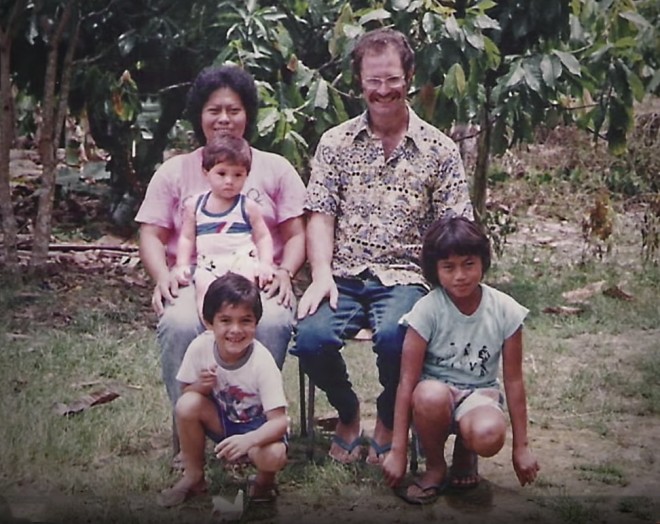
Before that, he worked in a hair salon in London until, in 2008, a Malaysian client suggested he return to Asia and try his luck with television. (On the BBC’s website, he is still listed as “a fully-trained hairstylist turned travel presenter”.)
In 2011, he met his wife Liv Lo at a party in Singapore. She is Italian-Taiwanese, a yoga instructor and television presenter. Golding is half Iban – a people who hail from Borneo in southern Malaysia. In preparation his 2016 wedding to Lo, he decided that he wanted to do his bejalai – the journey young Iban men undertake to gain knowledge and wisdom.
It became a six-part series, called Surviving Borneo, for Discovery Channel Asia.
Borneo is actually Golding’s birthplace: he was born in the Malaysian state of Sarawak, the youngest of three children. His parents had met in Brunei, where his father was in the British Army.
“My mom was working as an au pair for an expat family over there,” he says, “and they met, they fell in love, they married three or four months later and moved to the UK.” At first, the couple lived in army quarters, but his mother found it lonely, especially when their second child – Henry’s brother – was born while her husband was on a tour of duty in the Falklands.
“She learned her lesson with Dad being away and she thought, ‘I want to be back in Sarawak with my child, where I have a family.’ So I was born in Betong.” That was in 1987. Later, they moved to Terengganu, in Peninsular Malaysia, where his father worked as a helicopter engineer. Golding thinks he was about nine when they relocated to Britain.
In previous interviews, Golding has mentioned the playground racism he experienced on arrival in Surrey, in the UK, and it is not only external sneers he has had to contend with: part of the pernicious effect of racism can be the shameful tussle within.
“There was a stage when I was a little embarrassed about my Asian upbringing,” he admits. “Then it got to a stage where I was like, you know what, fuck that, it’s something to be happy about.” What triggered the transition? “I think just growing up. Leaving school. Then going to work and realizing the world is so much bigger.”
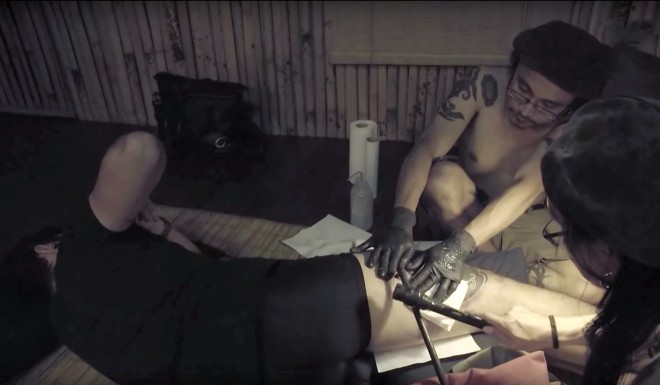
That was when he got his first tattoo. It’s on his right arm: Iban script that translates as “child of Sarawak, son of Margaret and Clive.” Where did he get it done? “Tony’s Tattoo Shop in Reigate [Surrey].” (A very big laugh.)
“My mum checked the grammar was correct, my dad helped design it.” So he, literally, had himself labeled Iban? “Pretty much, I guess. I’d just turned 18. The next tattoo – or two – was the brinjal, extremely traditional to the Iban.”
During his pec-flexing scenes in Crazy Rich Asians, you cannot see the actor’s nine tattoos. They were covered up. “Yeah, well, Nick Young is your traditionalist, I suppose,” he says. “You’re playing a character.” (In some ways, Golding’s next film A Simple Favor is a progression: no cover-up, no mention of ethnicity whatsoever, just a single reference to him being “British.”)
I’ve heard Golding on chat shows describe how he initially kept refusing to audition for the role of Nick Young. “I’m like, ‘No, no, no, no!’” he told Jimmy Fallon during his Late Show appearance. But I have also heard how he interrupted his South African honeymoon – though the trip was actually five months after the wedding – to fly off for a screen test, which suggests a more focused approach.
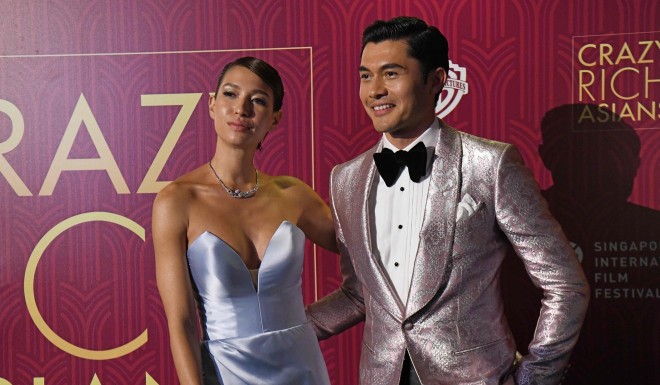
And now, he’s hooked. He wants to make “amazing movies.” Squeezed between the two mega-productions he has already finished and the two mega-productions he is about to begin, he has managed to make a much smaller film, called Monsoon.
He hopes it will be picked up at a festival and released next year. Golding plays a British-Vietnamese man who takes his parents’ ashes back to Saigon.
“He’s a man who’s been taken away from his culture at the age of four, so there are similarities.” He also happens to be gay. “It’s not even a big plot point, really. He’s a guy who messes around, falls in love; what humans do.”
Fame, inevitably, will bring its warp factor as he becomes public property. In Goldwyn’s era, that meant autographs; in Golding’s, it’s selfies.
“That’s the one thing that is driving me up the wall,” he says. “Some people don’t even say hello. They come up and say, ‘Can I take your picture?’ and I’m, like, why? And they say, ‘Oh, you’re that guy.’ And I’m, like, ‘Why do you want a photo of me if you don’t even know my name?’”
For just a brief second, he looks exasperated. Then he smiles his megawatt smile, the one that is going to dazzle guests later and raise more money for children at a charity ball in Hong Kong. “But then, you can’t say that. And you’re like, ‘Fine!’”
Source : https://www.inkstonenews.com/ by Fionnuala McHugh
 Indie Borneo