
Most people don’t fail financially because they lack knowledge—they fail because they rely too much on discipline.
Discipline fades. Systems don’t.
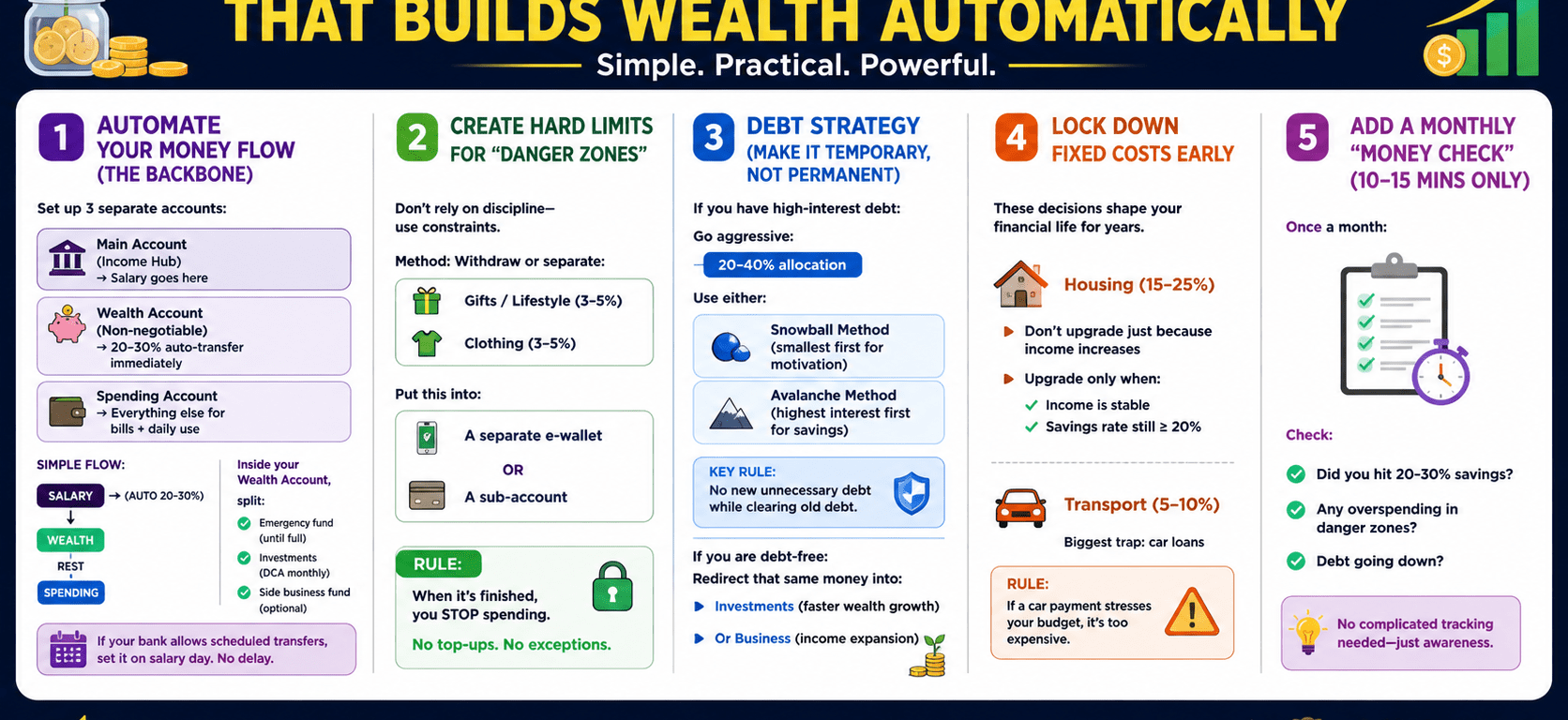
If you want to build real wealth while working full-time, you need a structure that runs automatically in the background. Here’s a simple, practical 5-step system that turns your income into long-term financial growth—without constant effort.
1. Automate Your Money Flow (The Backbone)
This is where everything starts.
Set up three separate accounts:
- Main Account (Income Hub)
→ Your salary goes here - Wealth Account (Non-negotiable)
→ Automatically transfer 20–30% immediately - Spending Account
→ Covers bills and daily expenses
The Flow:
Salary → (Auto 20–30%) Wealth → Spending
No thinking. No delay. No excuses.
Inside your Wealth Account, split your money into:
- Emergency fund (until you reach 3–6 months of expenses)
- Investments (monthly Dollar Cost Averaging into unit trusts or stocks)
- Side business fund (optional, but powerful)
👉 Set this transfer on salary day. If your bank allows scheduled transfers, use it.
Because if you don’t automate it—it won’t happen.
2. Create Hard Limits for “Danger Zones”
Some expenses don’t look dangerous—but they slowly destroy your finances.
The biggest culprits:
- Gifts / Lifestyle (3–5%)
- Clothing (3–5%)
These categories grow silently if left unchecked.
The Strategy:
Don’t rely on willpower. Use constraints.
- Separate this money into:
- A dedicated e-wallet
- Or a sub-account
The Rule:
When the money is gone, you STOP spending.
No top-ups. No exceptions.
This single habit can save you thousands every year.
3. Manage Debt Strategically (Make It Temporary, Not Permanent)
Debt isn’t just about money—it’s about momentum.
If you have high-interest debt:
Go aggressive:
- Allocate 20–40% of your income
Choose your approach:
- Snowball Method → Pay smallest debts first (build momentum)
- Avalanche Method → Pay highest interest first (save more money)
👉 Non-negotiable rule:
No new unnecessary debt while clearing old debt.
If you’re debt-free:
You’re in a powerful position.
Redirect that same 10–20% into:
- Investments (to accelerate wealth)
- Or a side business (to increase income)
4. Lock Down Fixed Costs Early
This is where most people make long-term mistakes.
Housing (15–25%)
- Don’t upgrade just because your salary increases
- Only upgrade when:
- Your income is stable
- Your savings rate stays above 20%
Transport (5–10%)
This is the biggest trap—especially car loans.
Simple Rule:
If your car payment stresses your budget, it’s too expensive.
Once locked in, these costs are hard to reduce—so choose wisely from the start.
5. Add a Monthly “Money Check” (10–15 Minutes Only)
You don’t need complex spreadsheets or daily tracking.
Just once a month, ask yourself:
- Did I save 20–30%?
- Did I overspend in lifestyle categories?
- Is my debt going down?
That’s it.
Awareness beats perfection.
🔑 Final Thought: Build Systems, Not Stress
This system works because it removes friction:
- You automate what matters
- You limit what leaks
- You control what can hurt you long-term
And most importantly:
You make wealth-building a default—not a decision.
Start simple. Stay consistent. Let the system do the heavy lifting.
Because financial success isn’t about doing more—it’s about setting things up so you don’t have to think about it every day.
 Indie Borneo