
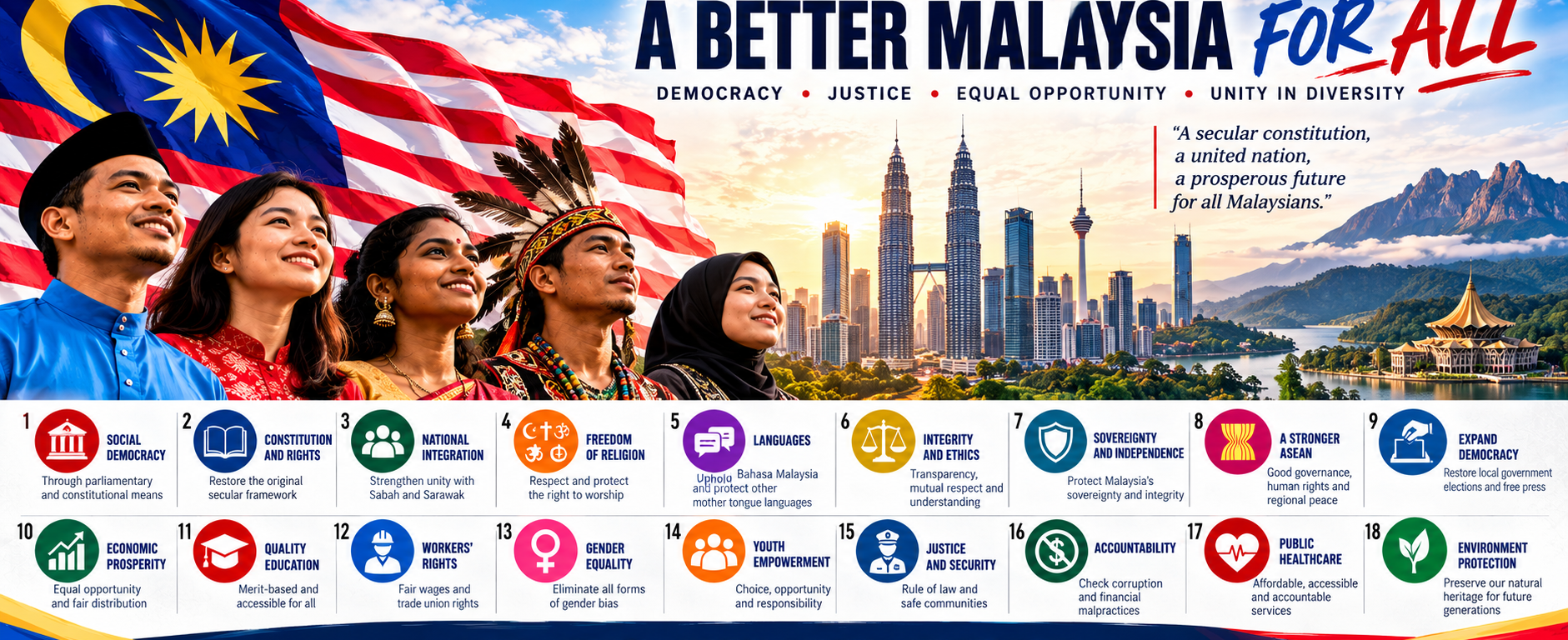
Building a Better Malaysia: The Merdeka Constitution, Democracy and Social Justice
A vision for a secular constitutional framework, equal opportunity, national unity, and a prosperous Malaysia for all.
Introduction: Returning to the Principles of Merdeka
Malaysia’s future depends not only on economic growth but also on the strength of its democratic institutions, the integrity of its government, and its commitment to justice, freedom, and human dignity.
The Merdeka Constitution represents an important foundation for discussions about Malaysia’s constitutional identity, democratic governance, and the protection of fundamental rights. The principles highlighted in this vision include democracy, freedom, the rule of law, equality, accountability, and respect for human rights.
These ideals have the potential to unite Malaysians across different ethnicities, religions, languages, and cultures. They can also strengthen the relationship between Peninsular Malaysia, Sabah, and Sarawak by promoting mutual respect and recognition of their respective histories and constitutional arrangements.
A progressive Malaysia should be a country where democracy advances alongside economic development, freedom does not become a tool of oppression, and prosperity benefits society more broadly.
The challenge is to build a nation where wealth creation goes hand in hand with fair distribution, where public institutions serve the people, and where economic progress is not undermined by corruption or abuse of power.
1. Establishing a Social Democracy
A central objective is to establish social democracy in Malaysia through parliamentary and constitutional means.
Social democracy seeks to combine democratic political institutions with social justice, economic opportunity, and protection for ordinary citizens. It recognises the importance of competitive markets while maintaining that economic development should serve the broader interests of society.
Under this approach, national progress should be measured not only by gross domestic product or investment figures but also by the quality of life of ordinary Malaysians.
Access to education, decent employment, healthcare, housing, and social protection should be important considerations in determining whether economic development is genuinely successful.
2. Upholding the Constitution and Fundamental Rights
The Constitution must remain the supreme legal framework governing the country.
This vision calls for reaffirming constitutional principles that protect democratic values, fundamental liberties, and the equal dignity of Malaysian citizens.
Constitutional government requires that public authorities exercise their powers within the law and remain accountable for their decisions. It also requires respect for fundamental rights and the institutions responsible for safeguarding them.
A stable constitutional framework provides citizens with confidence that their rights will not depend solely on political influence, social status, or personal connections.
The objective is to strengthen public trust through constitutional governance, equality before the law, and respect for democratic principles.
3. Strengthening National Integration with Sabah and Sarawak
Malaysia’s national unity must recognise the distinctive histories and circumstances of Sabah and Sarawak.
The formation of Malaysia in 1963 brought together territories with different historical experiences and political expectations. Building a stronger federation therefore requires meaningful dialogue, mutual respect, and recognition of the constitutional arrangements and rights associated with the formation of Malaysia.
For Sabah and Sarawak, questions concerning autonomy, development priorities, representation, and the implementation of relevant constitutional and Malaysia Agreement 1963 provisions remain important to discussions about federal relations.
National integration should not require the abandonment of regional identity. Instead, a united Malaysia should allow its constituent communities to preserve their cultural heritage while participating fully in national development.
True unity grows when citizens believe that their voices matter and that their rights and legitimate interests are respected.
4. Protecting Freedom of Religion
Freedom of religion is an essential element of a diverse society.
Malaysia’s different religious communities should be able to practise their faiths with dignity, subject to the constitutional and legal framework of the country.
This objective emphasises protection against oppressive laws and discriminatory practices affecting religious communities.
Respect for religious freedom also requires dialogue, tolerance, and an understanding that peaceful coexistence depends on recognising the dignity of people whose beliefs may differ from our own.
A harmonious society is not one in which everyone follows the same religion or worldview. It is one in which differences can be managed peacefully and individual rights are respected.
5. Promoting Bahasa Malaysia and Protecting Mother Tongue Languages
Bahasa Malaysia, as the national language, plays an important role in communication, education, and the development of a shared Malaysian identity.
At the same time, Malaysia’s linguistic diversity is an important part of its cultural heritage. Chinese, Tamil, English, and the Indigenous languages of Sabah and Sarawak contribute to the country’s educational, cultural, and social life.
Promoting the national language should therefore go hand in hand with opportunities to learn, preserve, and use other languages within the applicable constitutional and legal framework.
Language should serve as a bridge between communities rather than become a source of unnecessary division.
A multilingual society can strengthen national unity while preserving the traditions and knowledge passed down through generations.
6. Building Integrity, Ethics, and Mutual Respect
National development requires more than effective economic policies. It also depends on the ethical standards of public institutions and the conduct of those entrusted with authority.
Integrity, transparency, compassion, and accountability should guide public administration.
Government officials must act in the public interest, while citizens should have meaningful opportunities to question decisions and seek explanations when public resources are misused.
Mutual respect is equally important in a multicultural society. Differences in religious beliefs, cultural traditions, and personal values should be approached through understanding and constructive dialogue.
A culture of integrity can strengthen public confidence, improve institutional performance, and create a more stable environment for investment and development.
7. Protecting Malaysia’s Sovereignty and Independence
Malaysia’s sovereignty and territorial integrity are fundamental to its continued existence as an independent nation.
Protecting national sovereignty involves maintaining effective institutions, safeguarding territorial integrity, and ensuring that national decisions are made through legitimate constitutional processes.
However, sovereignty should also be understood in terms of the well-being and dignity of the population.
A strong nation requires capable institutions, a resilient economy, social cohesion, and citizens who can participate meaningfully in national life.
National independence becomes more meaningful when it is accompanied by responsible governance and opportunities for all citizens to contribute to the country’s future.
8. Building a Peaceful and Democratic ASEAN
Malaysia’s future is closely connected to the wider Southeast Asian region.
A stronger ASEAN community should promote good governance, democratic participation, respect for human rights, peaceful cooperation, and regional stability.
Cooperation among Southeast Asian countries can support trade, technological advancement, environmental protection, education, and economic resilience.
The objective also supports preserving Southeast Asia as a nuclear-free region and maintaining peace, freedom, and neutrality.
Regional prosperity is most sustainable when countries work together to resolve disagreements peacefully and respect one another’s independence.
9. Expanding Democracy and Restoring Local Government Elections
Democracy should extend beyond national and state elections.
Local government decisions directly affect daily life, including waste management, public facilities, local roads, planning, and neighbourhood development.
Restoring local government elections, as proposed in this vision, would give residents a more direct role in selecting local representatives and influencing decisions affecting their communities.
A democratic system also requires fair electoral processes, freedom of the press, and meaningful public participation.
When citizens can scrutinise local decisions and hold representatives accountable, public institutions have stronger incentives to respond to community needs.
Democracy becomes more effective when participation is continuous rather than limited to voting every few years.
10. Creating Wealth and Distributing Prosperity Fairly
Economic development should create opportunities while ensuring that prosperity is shared more equitably.
Competitive markets can encourage innovation, entrepreneurship, investment, and productivity. However, economic growth alone does not guarantee that its benefits reach every segment of society.
A fair economic order should address barriers that prevent people from improving their circumstances, including limited access to education, employment, capital, and essential services.
The objective is not to eliminate individual achievement or entrepreneurial success. Rather, it is to ensure that economic opportunities are accessible and that the rewards of development contribute to wider social well-being.
Malaysia should strive for an economy where hard work is rewarded, businesses can compete fairly, and ordinary households have realistic opportunities to improve their living standards.
11. Improving Education and Equal Opportunities
Education is one of the most important foundations of national progress.
Every Malaysian child should have access to quality primary and secondary education, while capable students should have opportunities to pursue tertiary education and professional development.
The vision emphasises merit and need as considerations in educational policy, alongside wider access to knowledge and information technology.
A modern education system must prepare students not only for examinations but also for employment, entrepreneurship, technological change, and responsible citizenship.
Investing in teachers, learning facilities, digital skills, and vocational education can help prepare young Malaysians for a changing economy.
Educational opportunity should help individuals develop their potential regardless of their family background or place of residence.
12. Protecting Workers and Trade Union Rights
Workers are central to economic development, and their contributions should be recognised through fair employment practices.
This objective emphasises the right to work, decent wages, protection of trade union rights, and the maintenance of workers’ real purchasing power.
As living costs rise, nominal wage increases may not necessarily improve household well-being if prices increase faster than earnings.
A fair labour framework should therefore consider wages, working conditions, workplace safety, job security, and opportunities for skills development.
Workers should also have appropriate channels to raise concerns and negotiate employment conditions.
Protecting workers and supporting productive businesses need not be contradictory. A healthy economy benefits when employers can grow while workers receive fair treatment and a reasonable share of the value they help create.
13. Eliminating Gender Discrimination
Women should have equal opportunities in education, employment, healthcare, and public life.
Gender discrimination can restrict individual potential, reduce economic participation, and undermine social development.
Addressing it requires fair recruitment and promotion practices, protection against harassment, access to healthcare, and opportunities for women to develop their professional and leadership capabilities.
A society that enables women to participate fully benefits from a wider pool of talent, experience, and innovation.
Gender equality is therefore both a matter of human dignity and an important component of national development.
14. Empowering the Younger Generation
Young people represent Malaysia’s future workforce, leadership, and capacity for innovation.
Empowering them means giving them opportunities to participate in decision-making, develop their skills, and pursue meaningful careers.
Young Malaysians need access to quality education, affordable opportunities for further study, employment, entrepreneurship, and constructive civic participation.
At the same time, empowerment should be accompanied by responsibility, critical thinking, and respect for the rights of others.
Young people should not be treated merely as voters or beneficiaries of government programmes. They should be recognised as active participants in shaping public policy and national priorities.
A country that listens to its youth is better positioned to understand emerging challenges and develop solutions for the future.
15. Ensuring Justice, Security, and Safe Communities
Public safety and justice are essential to a society in which people can live, work, and raise families with confidence.
The rule of law requires that laws be applied fairly and that individuals have access to impartial legal processes.
Safe neighbourhoods also depend on effective public services, responsible policing, adequate infrastructure, and cooperation between residents and local authorities.
Preventing crime requires attention not only to law enforcement but also to the social conditions that can contribute to insecurity, including poverty, unemployment, inadequate housing, and limited access to support services.
Justice and security should reinforce one another while respecting fundamental rights and the dignity of every individual.
16. Fighting Corruption and Strengthening Accountability
Corruption undermines public trust, wastes resources, distorts competition, and weakens institutions.
A government committed to integrity must establish transparent procedures, effective oversight, and meaningful consequences for financial misconduct.
Public procurement, government spending, political financing, and the management of public assets are areas where strong accountability mechanisms are particularly important.
Independent oversight, professional public administration, access to information, and protection for legitimate whistleblowing can help reduce opportunities for abuse.
Fighting corruption should not be a partisan exercise. It should be a consistent national commitment that applies regardless of political affiliation or position.
Public office is a responsibility entrusted by the people, not a personal entitlement.
17. Providing Affordable and Accessible Healthcare
Healthcare is a fundamental part of human well-being and social security.
An effective public healthcare system should provide accessible, affordable, and accountable services to people who need medical treatment, rehabilitation, long-term care, or support in old age.
This objective highlights the needs of sick and vulnerable people, including older citizens and those who require continuing assistance.
Achieving it requires attention to healthcare facilities, medical personnel, preventive care, essential medicines, and access to services in rural and remote communities.
In Sabah and Sarawak, geographical challenges make the accessibility of healthcare particularly important for communities located far from major hospitals.
A healthier population can participate more fully in education, employment, family life, and national development.
18. Protecting the Environment and Malaysia’s Natural Heritage
Malaysia’s forests, rivers, coastlines, wildlife, and biodiversity form an important part of its natural heritage.
Environmental degradation can threaten public health, livelihoods, food security, and the well-being of future generations.
Protecting the environment requires responsible land use, effective enforcement of environmental regulations, sustainable resource management, and investment in cleaner technologies.
Sabah and Sarawak, with their significant forest ecosystems and Indigenous communities, illustrate the close relationship between environmental protection, cultural heritage, and local livelihoods.
Development should therefore consider long-term environmental costs alongside immediate economic benefits.
A clean, healthy, and safe environment is not merely an additional benefit of prosperity. It is one of the foundations of a sustainable society.
Conclusion: A Shared Vision for Malaysia’s Future
The preamble and 18 objectives outlined here present a broad vision of Malaysia built on constitutional government, democracy, human rights, social justice, economic opportunity, and national unity.
They connect political reform with everyday concerns: education, wages, healthcare, housing, public safety, environmental protection, and the relationship between the federal government and Sabah and Sarawak.
Their central message is that national progress should be measured not only by economic growth but also by the fairness of institutions, the quality of public services, and the opportunities available to ordinary citizens.
Realising this vision requires responsible leadership, effective institutions, public participation, and a willingness to discuss difficult questions through peaceful and constitutional means.
Malaysia’s diversity need not be an obstacle to national unity. With mutual respect, fair opportunities, accountable governance, and recognition of its different communities, diversity can become a source of strength.
The ultimate goal is a Malaysia where freedom is protected, justice is accessible, prosperity is shared, and every citizen can look towards the future with dignity, confidence, and hope.
Source : DAP Malaysia

