
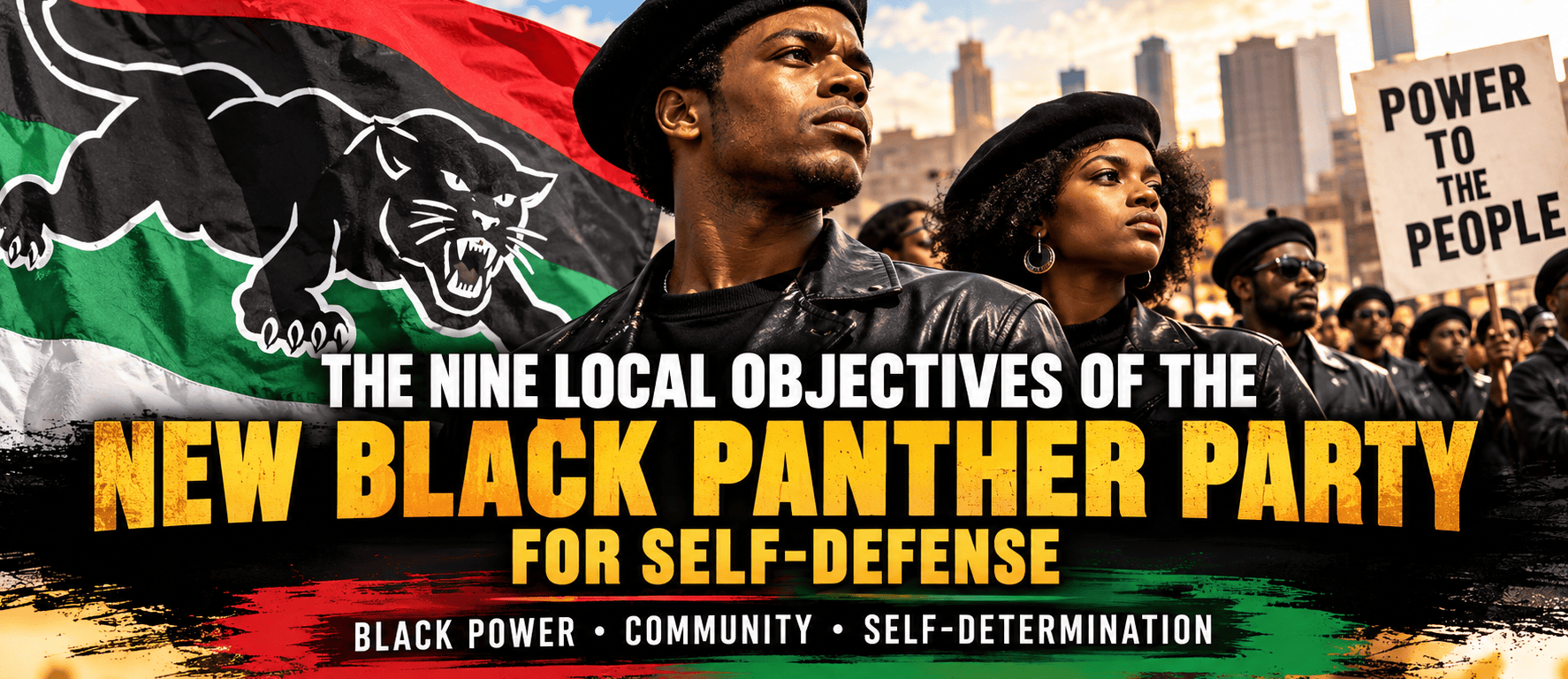
Understanding the political philosophy, community agenda, and demands for social and economic justice in the New Black Panther Party’s local programme.
Introduction: Defining Black Power
The New Black Panther Party for Self-Defense (NBPP) presents Black Power as a political philosophy centred on defining, developing, and defending what it considers to be the best interests of Black people. Its local objectives outline an ambitious agenda encompassing political participation, economic independence, education, community development, youth empowerment, police accountability, and reparations.
The programme reflects a broader tradition of Black liberation movements that have sought to confront racial discrimination, challenge unequal distributions of power, and strengthen the capacity of Black communities to determine their own futures.
At the heart of the programme is a central proposition: a community cannot achieve meaningful freedom without the knowledge, economic resources, political influence, and collective organisation necessary to shape its own destiny.
The nine local objectives provide a framework for understanding how the organisation proposes to pursue that vision.
1. Building a Black Power Movement
The first objective focuses on organising a local movement capable of advancing the interests of the Black community.
The programme emphasises collective responsibility, unity, solidarity, and cooperation among community organisations, religious institutions, political leaders, and activists. It also calls for accountability among leaders who, in the organisation’s view, fail to represent the interests of their communities.
The objective extends beyond political mobilisation. It also recognises the importance of spiritual and moral principles in sustaining a movement for liberation, while stating that the party itself is not a religion.
The underlying message is that meaningful social change requires more than individual determination. It requires organised people who share a purpose, build alliances, and accept responsibility for their community’s future.
2. Developing Black Power Through Education
Education is presented as a fundamental instrument of empowerment.
The programme calls for greater community involvement in public education, the teaching of Black history, and the development of independent African-centred educational institutions. It also encourages young people to pursue university degrees, professional qualifications, and vocational training.
Importantly, education is understood in a broad sense. The programme includes historical awareness, knowledge of personal identity, health education, and the ability to understand and defend one’s interests.
This objective reflects the belief that education should prepare people not only for employment but also for informed citizenship and leadership.
A community that understands its history and develops its intellectual capabilities is better equipped to challenge discrimination, participate in public affairs, and create opportunities for future generations.
3. Developing and Defending Economic Power
Economic independence is another central pillar of the programme.
The organisation advocates the development of Black-owned businesses, financial institutions, retail outlets, restaurants, and other commercial enterprises. It also encourages consumers to support businesses within their communities and calls for stronger trade relationships with Africa and other parts of the world.
The programme draws inspiration from historical economic initiatives associated with Marcus Garvey’s Universal Negro Improvement Association (UNIA) and the Nation of Islam.
Its underlying argument is that political rights alone may not be sufficient to achieve meaningful independence when a community lacks control over its economic resources.
Local ownership can help create employment, retain wealth within a community, and support the development of future entrepreneurs.
The programme also rejects economic exploitation regardless of the identity of the exploiter and promotes cooperative economics as a means of strengthening collective prosperity.
4. Developing and Defending Political Power
The fourth objective focuses on political participation, representation, and self-determination.
The programme recognises that political institutions influence the allocation of public resources, the development of neighbourhoods, and the enforcement of laws. It therefore calls for active engagement with local councils, school boards, regional governments, and national political institutions.
It also advocates supporting political candidates who meet the organisation’s stated objectives and holding elected representatives accountable for their decisions.
Another major theme is self-determination: the principle that communities should have a meaningful role in determining their political, economic, and social futures.
The programme argues that political influence is limited when it is disconnected from economic independence and historical awareness. It consequently links political organisation to the development of community institutions and economic resources.
This objective illustrates the organisation’s position that representation must be accompanied by accountability and the practical ability to influence decisions.
5. Ensuring Accountability in Law Enforcement and Criminal Justice
The fifth objective addresses police misconduct, discrimination, and the treatment of Black people within the criminal justice system.
The programme calls for greater police accountability, community oversight, and protection of constitutional and human rights. It also advocates legal mechanisms through which allegations of police misconduct can be investigated and addressed.
The organisation states that it supports respectful relationships with law enforcement officers who respect the communities they serve. At the same time, it argues that public institutions must be answerable to the people affected by their actions.
The programme also highlights incarceration, the treatment of prisoners, and the experiences of people it considers political prisoners or victims of racially motivated injustice.
At its core, this objective raises questions about institutional accountability, equal treatment under the law, public trust, and the protection of civil rights.
Any effective approach to these issues must also ensure that oversight mechanisms operate lawfully, investigations are impartial, and individual rights are protected.
6. Developing and Defending Black Youth
The sixth objective identifies young people as essential participants in the future of the community.
The programme seeks to develop youth leadership, improve educational opportunities, expand access to employment, and address gang violence and violence within the Black community.
It also opposes the disproportionate criminalisation and incarceration of young people and calls for financial resources to support their education and development.
This emphasis reflects an important principle of community development: young people should not be viewed merely as recipients of assistance but as potential leaders, innovators, and contributors to society.
Investment in education, vocational training, mentoring, employment, and youth participation can help create pathways towards greater independence and social mobility.
The programme’s focus on youth therefore connects directly with its wider objectives concerning education, economic development, and political empowerment.
7. Reclaiming and Developing Black Neighbourhoods
The seventh objective centres on neighbourhood improvement and community solidarity.
The programme proposes community clean-up activities, neighbourhood events, assistance for homeless people, and efforts to improve local living conditions.
It also raises concerns about gentrification and the displacement of established residents when neighbourhoods undergo economic and physical redevelopment.
These concerns reflect wider debates about housing affordability, access to public services, property ownership, and the ability of long-standing communities to remain in the places they call home.
The programme also advocates a community culture built around respect, cooperation, responsibility, peace, and unity.
Although communities may disagree about the best methods of neighbourhood development, the underlying issues are widely relevant: residents need safe environments, affordable housing, adequate healthcare, and meaningful participation in decisions affecting their homes.
8. Defending Black Rights and Opposing Discrimination
The eighth objective expands the programme’s focus to the protection of civil and human rights.
It identifies discrimination in government, business, policing, housing, and consumer relations as areas of concern. It also calls for cooperation among legal organisations, attorneys, religious leaders, activists, and community groups.
This objective presents the defence of rights as an organised responsibility rather than an individual undertaking.
Legal knowledge, access to representation, public awareness, and effective community advocacy can all contribute to challenging discriminatory practices.
The programme’s emphasis on collective action also raises the importance of building institutions capable of documenting grievances, supporting affected individuals, and pursuing lawful remedies.
The broader principle is that equality requires not only formal recognition of rights but also practical mechanisms to protect those rights when they are threatened.
9. Demanding Reparations and Compensation
The ninth objective calls for reparations for historical slavery, racial discrimination, dispossession, and other forms of injustice.
The programme argues that governments, corporations, and private individuals who benefited from these historical injustices should contribute financial resources, land, and other forms of compensation.
It proposes using reparations to rebuild community institutions and strengthen the economic and social foundations of the Black population.
Reparations remain a significant subject of political and historical debate. Proposals vary considerably, including direct financial payments, community investment, educational funding, land restoration, housing assistance, and institutional reforms.
Debates over reparations frequently involve questions about historical responsibility, the identification of beneficiaries, the measurement of harm, and the design of practical programmes.
Within the NBPP’s local objectives, reparations are presented as a means of addressing accumulated historical disadvantages and providing resources for long-term community development.
The Common Thread: Collective Empowerment
Considered together, the nine objectives form a connected political and social programme.
Education is intended to develop knowledge and leadership. Economic development seeks to strengthen material independence. Political participation aims to increase influence over public decisions. Youth development prepares future generations, while neighbourhood improvement and civil-rights advocacy address immediate community concerns.
Reparations, meanwhile, are presented as a means of securing resources to address historical injustice.
These objectives are interconnected. Educational achievement can strengthen economic opportunities, economic resources can support political participation, and effective political representation can influence public investment in schools, housing, and community services.
However, the programme also reflects the organisation’s specific ideological positions, including its emphasis on Black nationalism and its opposition to integrationism. Its proposals should therefore be understood in the context of its own political philosophy rather than treated as a universally accepted framework.
Conclusion: From Political Principles to Community Development
The nine local objectives of the New Black Panther Party for Self-Defense present a vision of Black empowerment that extends beyond electoral politics.
They encompass education, economic ownership, political organisation, youth leadership, neighbourhood development, civil rights, and reparations. Together, they express the belief that communities require both collective organisation and practical resources to address persistent inequalities.
The programme also invites broader questions about how movements translate political principles into effective institutions, how leaders remain accountable to their communities, and how social change can be pursued while protecting the rights and dignity of all people.
Ultimately, its significance lies in the range of issues it brings together under the concept of self-determination: the relationship between identity, knowledge, economic resources, political power, and the capacity of a community to shape its future.
Understanding these objectives provides a useful starting point for examining the history, ideology, and continuing debates surrounding Black liberation movements and community empowerment.
Source : New Black Panther Party for Self Defense

