
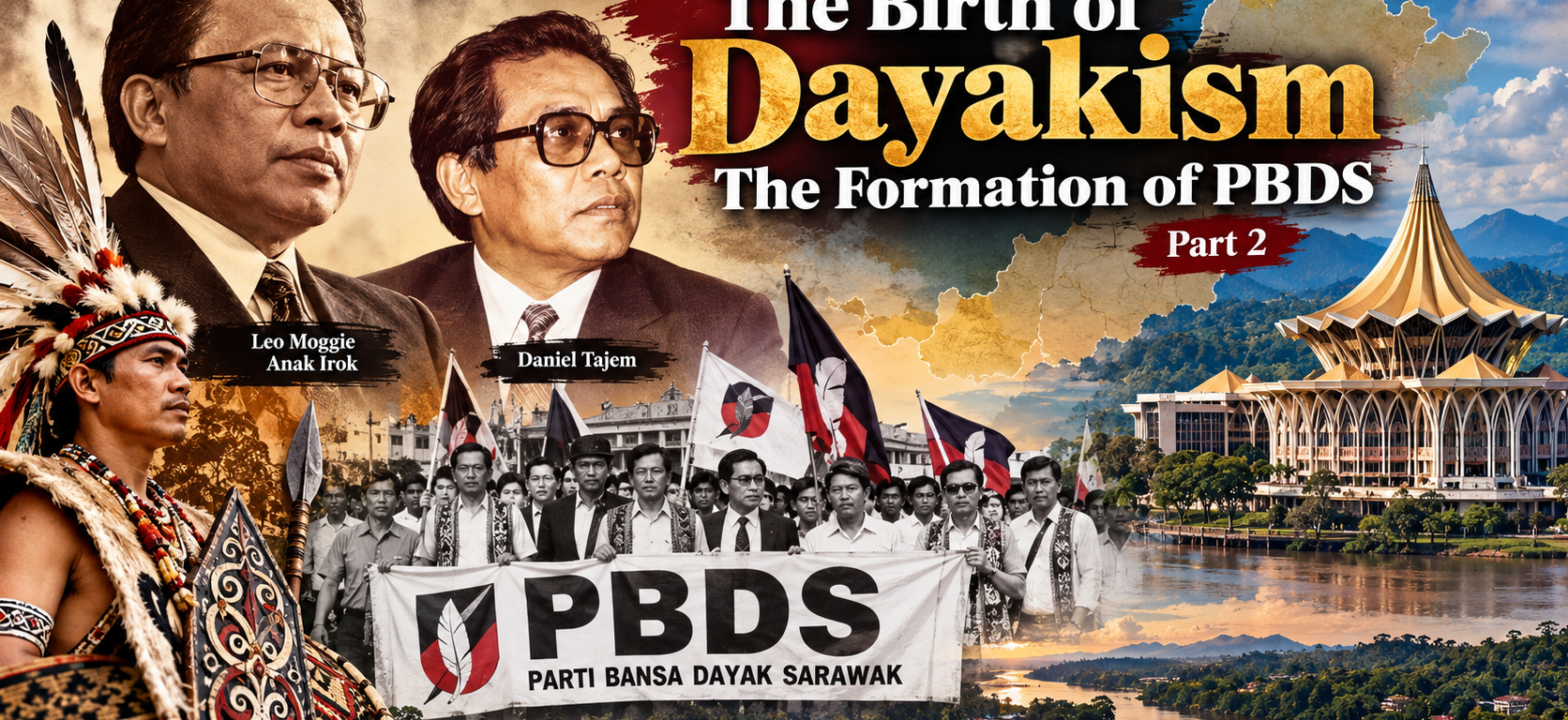
The Rise of Parti Bansa Dayak Sarawak and the Quest for Dayak Political Power
The Birth of a Political Movement
In 1983, Sarawak witnessed a significant turning point in its political history with the formation of Parti Bansa Dayak Sarawak (PBDS). More than the establishment of another political party, PBDS represented the growing desire among sections of the Dayak community to assert their political identity, strengthen their representation, and secure a greater role in determining the future of Sarawak.
Led by Datuk Amar Leo Moggie anak Irok, with Daniel Tajem as a key political figure and deputy president, PBDS emerged from a split within the Sarawak National Party (SNAP). The new party would become one of the most influential Dayak-based political organisations in Sarawak during the 1980s and 1990s.
To understand the birth of PBDS, however, one must look beyond the personalities involved. Its formation reflected deeper tensions concerning ethnic representation, generational change, political leadership, and the future direction of Dayak politics.
The Crisis Within SNAP
SNAP had long played an important role in representing the interests of the Dayak community, particularly the Iban population. However, disagreements over leadership and the party’s political direction gradually exposed divisions within its ranks.
Following the departure of Datuk Dunstan Endawie Enchana from the party presidency, questions arose over his successor. James Wong Kim Min, a prominent Chinese leader within SNAP, became a central figure in the succession debate.
A section of younger, educated Iban members believed that a party historically associated with Dayak political representation should be led by a Dayak. Others within the party supported James Wong, reflecting different views about leadership, political cooperation, and the preservation of established power structures.
The dispute was not simply a contest between Dayak and non-Dayak leaders. It also revealed a generational divide between younger members seeking political change and established leaders determined to maintain their influence.
The underlying question was fundamental: Should SNAP remain a multiracial political organisation under established leadership, or should it prioritise Dayak leadership as a means of strengthening indigenous political representation?
The failure to reconcile these competing positions contributed to the eventual emergence of PBDS.
Daniel Tajem and the Political Breakaway
Daniel Tajem became an important figure in the developments leading to the formation of PBDS. His disagreements with the SNAP leadership intensified during the early 1980s, particularly following political disputes surrounding the 1982 state election.
Tajem’s expulsion from SNAP in 1983 further deepened the crisis. Despite losing his party membership, he did not immediately relinquish his position as Deputy Chief Minister.
Chief Minister Abdul Taib Mahmud’s handling of the situation formed part of the wider political calculations of the period. The presence of Tajem in the government, despite the breakdown in his relationship with SNAP, demonstrated how party conflicts and coalition politics could intersect in Sarawak.
For the Dayak political movement, the crisis created an opportunity. Instead of remaining divided within SNAP, dissatisfied members could organise around a new political platform that placed Dayak identity and representation at the centre of its agenda.
Thus, PBDS was born out of both political conflict and a broader aspiration for indigenous political empowerment.
Dayakism: Beyond Ethnic Identity
The emergence of PBDS marked a defining moment in what has been described as the birth of Dayakism.
Dayakism, in this historical context, refers to the development of a broader political consciousness among Dayak communities. It sought to bring together people from different Dayak groups under a shared identity and a common political objective.
The importance of this development cannot be understood through electoral politics alone. For a community whose political interests had often been channelled through competing parties and alliances, a dedicated Dayak-based organisation offered the possibility of a stronger collective voice.
PBDS provided a platform through which Dayak leaders could articulate concerns about political representation, access to government, indigenous interests, and the distribution of political influence.
The concept of Dayak identity also carried an important symbolic message: Dayak communities could regard themselves not merely as individual ethnic groups, but as part of a wider political constituency with shared interests in Sarawak’s future.
This was a significant development in a state characterised by ethnic diversity and coalition-based politics.
However, a shared identity alone could not guarantee political unity. Building a lasting movement required more than ethnic solidarity. It required capable leadership, sound political judgement, strong institutions, and a coherent strategy for achieving long-term objectives.
The Vision of Daniel Tajem and Leo Moggie
Daniel Tajem and Leo Moggie became central figures in the early development of PBDS, although their respective roles and political approaches should not be treated as identical.
Tajem was widely associated with the political drive behind the formation of a separate Dayak-based party. His vision recognised that the Dayak community’s demographic significance could potentially be translated into greater political influence.
Moggie, meanwhile, became the party’s leading figure and helped establish PBDS as a significant force in Sarawak politics.
Their political challenge was to transform the idea of Dayak unity into an effective organisation capable of competing in elections, negotiating within government, and advancing the interests of its supporters.
A number of prominent Dayak political figures joined the new party or became associated with its development, including James Jemut Masing, Edmund Langgu Saga, Gramong Juna, Ambrose Gramong, Edwin Tangkun, and others.
Their involvement reflected the significance of PBDS as a political alternative for Dayak leaders and voters.
Yet the party faced a strategic dilemma from its earliest years: should it remain an independent vehicle for Dayak political aspirations, or should it join a larger national coalition in order to gain access to government and influence policy?
The Barisan Nasional Dilemma
One of the most consequential decisions in PBDS’s history was its participation in Barisan Nasional (BN), the ruling national coalition.
Joining BN offered practical political advantages. A party outside the governing coalition might win seats but struggle to influence government decisions. Membership in the ruling alliance, by contrast, could provide access to ministerial positions, development resources, and the machinery of government.
Nevertheless, participation in a larger coalition also carried risks.
A smaller component party had to negotiate with more powerful coalition partners whose interests did not necessarily coincide with its own. Political influence depended not only on electoral strength but also on bargaining power, internal unity, leadership credibility, and the ability to negotiate favourable outcomes.
This raised a difficult question for Dayak political leaders: could participation in BN strengthen Dayak representation, or might it limit the party’s ability to challenge the political arrangements of which it had become a part?
The answer cannot be reduced to a simple judgement that joining BN was either entirely right or entirely wrong. Coalition participation could provide real opportunities, but its long-term value depended on how effectively those opportunities were used.
Political representation is not measured solely by the number of leaders holding government positions. It must also be measured by the policies achieved, the interests defended, and the institutional strength built for future generations.
The 1987 Election: PBDS Establishes Its Strength
The 1987 Sarawak state election demonstrated the electoral significance of the new political alignment.
PBDS won 15 seats, while the competing Permas grouping won five. The wider electoral contest also involved SNAP and the established Sarawak component parties of Barisan Nasional.
The result demonstrated that PBDS had established itself as a major political force with a substantial electoral base.
Its success also illustrated the potential of a political organisation capable of mobilising voters around Dayak representation and dissatisfaction with existing political arrangements.
However, electoral success presented its own challenge. Winning seats was only the beginning. The more difficult task was to convert electoral support into sustained influence over policy, development, political appointments, and the long-term position of Dayak communities within Sarawak.
A party can win elections and still struggle to achieve its wider political objectives if it lacks strategic independence, internal cohesion, or a clear programme for institutional development.
The Unfinished Project of Dayak Political Unity
The subsequent history of PBDS revealed the fragility of political unity built around a common identity.
Leadership disagreements eventually divided the party, culminating in a major crisis between Daniel Tajem and Dr James Jemut Masing. The party was deregistered in the early 2000s, with competing political initiatives emerging from the aftermath.
Parti Rakyat Sarawak (PRS), associated with James Jemut Masing and Sng Chee Hua, became one of the major political outcomes of the split. Attempts to establish alternative organisations, including the Malaysian Dayak Congress, also formed part of the political realignment. A later initiative sought to revive PBDS under the name Parti Bansa Dayak Sarawak (Baru).
These developments exposed a recurring problem in Dayak politics: the difference between unity as an ideal and unity as a functioning political institution.
Shared ancestry, cultural heritage, and political aspirations may provide a foundation for collective action, but they cannot eliminate competition over leadership, resources, strategy, and personal ambition.
When political organisations become overly dependent on individual leaders, succession disputes can threaten the movement itself. When disagreements cannot be resolved through trusted institutions, fragmentation becomes more likely.
The history of PBDS therefore raises an enduring question: how can Dayak political unity be sustained beyond the leadership of any single generation?
Lessons for the Future of Dayak Politics
The story of PBDS offers several lessons for contemporary Sarawak politics.
First, identity must be accompanied by a clear political programme. A shared Dayak identity can mobilise support, but lasting progress requires policies that improve education, economic opportunities, infrastructure, land rights, and institutional representation.
Second, political participation must be matched by negotiating strength. Joining a governing coalition can open doors, but political leaders must demonstrate that their participation produces tangible benefits for the communities they represent.
Third, leadership succession must be institutionalised. A movement that depends excessively on a few influential personalities risks disintegration when those personalities disagree or leave the political stage.
Fourth, unity must be inclusive. Dayak political cooperation requires respect for the diversity of Iban, Bidayuh, Orang Ulu, and other communities commonly associated with the broader Dayak identity. Unity should not erase their distinct histories, cultures, and interests.
Finally, political success must be evaluated over generations rather than election cycles. A movement’s real legacy lies not merely in the number of seats it wins, but in the strength of the institutions, opportunities, and political consciousness it leaves behind.
Conclusion: The Birth of Dayakism Was Only the Beginning
The formation of PBDS in 1983 was a landmark in Sarawak’s political history. It represented an effort to transform Dayak identity into a more organised political force and to create a platform through which Dayak leaders could pursue greater representation.
Yet the history of PBDS also demonstrates that political identity, electoral victories, and participation in government do not automatically translate into lasting collective power.
The party’s rise revealed the potential of Dayak political mobilisation. Its subsequent divisions exposed the costs of leadership conflict and the difficulties of sustaining a common political project.
For contemporary Dayak politics, the historical lesson is clear: the birth of Dayakism must be understood not merely as the creation of an ethnic-based political party, but as the beginning of an unfinished struggle to build unity, political competence, economic strength, and enduring institutions.
The question for the present generation is not simply whether Dayakism can be revived. It is whether the ideals associated with its birth can be translated into a more mature, inclusive, and effective political movement for the future of Sarawak.
Source : Dayak Baru Agenda

