
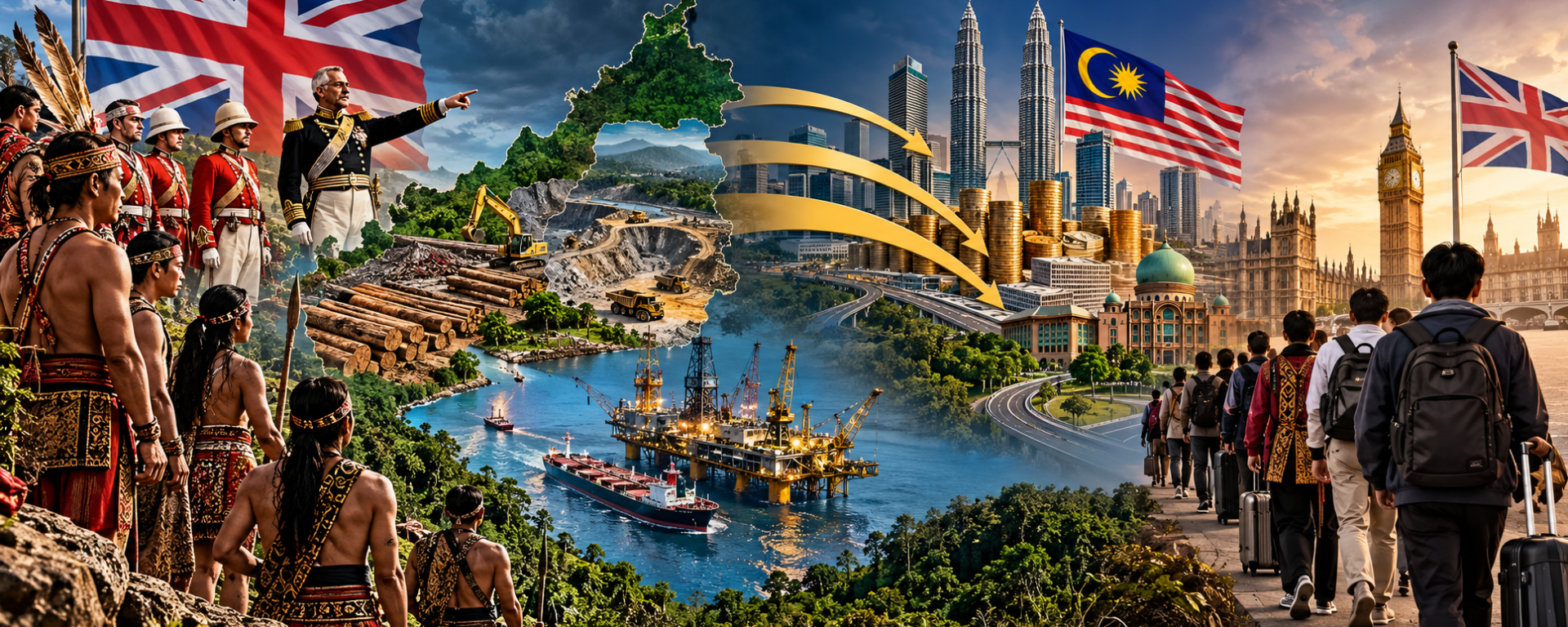
Borneo: From British Colonialism to Malayan Domination — Who Really Owns Our Wealth?
The Colonial Story That Borneo Must Never Forget
For generations, Borneo has been a land of immense natural wealth, cultural diversity and strategic importance. Its forests, oil and gas, minerals, fertile land and seas have supported communities long before European colonial powers arrived.
Yet the wealth of this island has repeatedly attracted outsiders seeking economic and political advantage.
Under British colonial rule, parts of Borneo were administered according to British imperial interests. Sarawak, North Borneo (now Sabah) and Brunei experienced different colonial arrangements, and their histories must not be treated as identical. Nevertheless, the broader question remains: how much of Borneo’s wealth and political destiny was determined by its own people, and how much was determined by external powers?
Borneo was rich, but its people did not always control the decisions affecting that richness.
From British Rule to the Formation of Malaysia
The end of British colonialism did not mean that every question of sovereignty, economic justice and political equality was settled.
In 1963, the Federation of Malaysia was formed with Malaya, Singapore, Sarawak and North Borneo. Brunei did not join the federation, while Singapore later separated in 1965.
The formation of Malaysia was accompanied by constitutional arrangements and safeguards intended to address the distinct positions of Sabah and Sarawak. The Malaysia Agreement 1963 (MA63) remains central to debates about the rights, autonomy and federal relationship of these two Bornean states.
But more than six decades later, a difficult question continues to trouble many people in Borneo:
Did the end of British colonial rule bring genuine self-determination, or did it leave Borneo in a new relationship of unequal power?
This is not a question that can be answered merely by pointing to a flag, a national anthem or the existence of elections. It requires an honest examination of political representation, fiscal arrangements, natural-resource revenues, development priorities and the ability of Bornean communities to determine their own future.
Is Borneo Still Economically Colonised?
Colonialism traditionally involved foreign political control and the extraction of resources for the benefit of an external power. Modern economic domination can take different forms, even where a territory is formally part of an independent country.
Critics of Malaysia’s federal system argue that Sabah and Sarawak have not always received a fair return for their contributions to the national economy. Oil and gas, timber, land and other resources have become central to arguments over federal revenue, royalties, development funding and state autonomy.
The issue is not simply whether money is spent in Borneo. It is whether the people of Borneo have sufficient power to determine how their resources are managed, how revenues are distributed and which development priorities deserve investment.
When communities continue to face inadequate infrastructure, uneven access to essential services and persistent rural poverty despite living in resource-rich territories, demands for accountability are entirely legitimate.
However, a serious movement for change must examine actual budgets, revenue flows, constitutional provisions and development outcomes rather than assuming that every inequality has the same cause.
If Borneo contributes significantly to national prosperity, its people deserve transparency, fairness and meaningful control over their economic future.
Why Should Borneans Continue to Accept Political Dependence?
Borneo is not merely a resource frontier. It is home to Indigenous peoples, distinct cultural traditions, diverse languages and communities with their own histories of governance and political struggle.
The question is whether the current federal relationship fully respects that diversity.
A fair federation should not require Sabah and Sarawak to surrender their distinct interests in exchange for development. Nor should the central government treat demands for autonomy as acts of disloyalty.
The legitimate demands are straightforward:
- Full and transparent implementation of the Malaysia Agreement 1963 and relevant constitutional safeguards.
- Fair, accountable arrangements for resource revenues and federal funding.
- Stronger state authority where constitutionally justified.
- Greater Indigenous participation in decisions involving customary land and natural resources.
- Better infrastructure, education, healthcare and economic opportunities.
- Political institutions that answer to the people of Borneo rather than powerful elites.
The objective should be to replace dependency with genuine partnership.
Should Borneans Migrate to Britain?
Some may ask a provocative question: if British imperial policies helped shape Borneo’s modern political history, why should Borneans not migrate to Britain and confront the former colonial power on its own territory?
There is a legitimate historical argument behind that question. Britain should not be exempt from scrutiny simply because its empire has ended. Its colonial legacy deserves examination, public debate and historical accountability.
But migration should not be confused with revenge.
Moving to Britain, building successful lives there, establishing Bornean communities and challenging colonial narratives through journalism, research, political participation and public advocacy can all be constructive ways to confront that history.
The goal should be to dismantle the legacy of colonial domination, not to destroy a country or punish ordinary people for the actions of a former empire.
Britain’s colonial history is part of a much wider story involving imperial governments, commercial interests and political elites. The people who live in Britain today are not collectively responsible for every historical injustice. Nor would destroying British institutions or harming its population restore Borneo’s lost opportunities.
A stronger response is to demand historical honesty, support affected communities, challenge exploitative systems and build institutions that protect Borneo’s interests.
The Real Revolution Must Begin in Borneo
Perhaps the greatest danger to Borneo is not merely that external powers once controlled its resources. It is that Borneans may continue to lack the political unity, institutional strength and economic independence needed to determine their own future.
No amount of anger alone can build a prosperous society.
Borneo needs educated citizens, accountable leaders, independent media, transparent public finances, strong local enterprises and a generation willing to challenge corruption and political patronage.
It needs a serious debate about federalism, autonomy and self-determination, grounded in history, law and the expressed wishes of its people.
If greater autonomy is the objective, it must be pursued through organised civic action, constitutional advocacy, democratic elections, public education and peaceful political mobilisation. If a different constitutional future is proposed, it must be debated openly, with attention to legal realities, economic consequences and the consent of the people concerned.
The future of Borneo should not be dictated by London, Kuala Lumpur or any other external centre of power. It should be shaped by the people who call this island home.
Borneo Must Never Be Anyone’s Colony Again
The central lesson of colonial history is that political freedom means little without the power to shape economic destiny.
Borneo should not remain trapped between the memory of British imperialism and present-day disputes over federal power. It must have the confidence to examine its history honestly, demand accountability from every government and build a future based on justice, prosperity and self-determination.
Britain cannot undo its imperial past. Malaysia cannot erase the historical questions surrounding the formation of the federation. But both history and present-day institutions can be scrutinised, and political arrangements can be challenged through legitimate democratic means.
The question for Borneans is no longer simply who took control in the past.
The more important question is this:
What are the people of Borneo prepared to do, peacefully and democratically, to ensure that their wealth, land, identity and future are governed in their interests?
The answer must begin with knowledge, unity, accountability and the courage to demand a fairer future.
Borneo belongs in the hands of its people—not as a possession of any empire, government or political elite, but as a homeland whose future must be determined by those who live here.

