
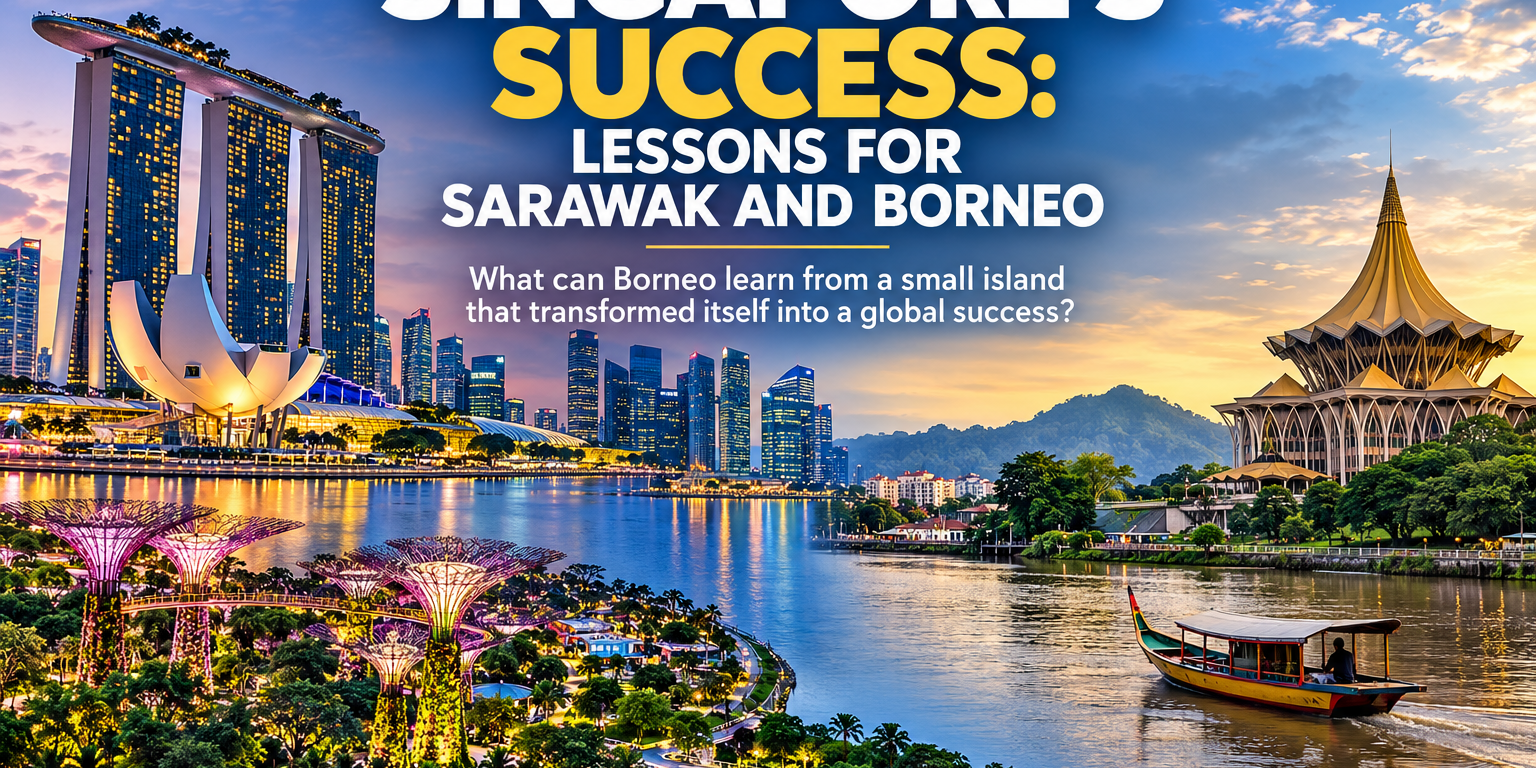
What can Borneo learn from a small island that transformed itself into one of the world’s most successful economies?
A Nation Built Against the Odds
Singapore’s journey from a resource-poor island to a global economic powerhouse is one of the most remarkable development stories of modern times.
When Singapore became independent on 9 August 1965, its future was uncertain. It had limited natural resources, a small domestic market, serious housing challenges and a population divided by ethnic, linguistic and cultural differences.
Yet, within a few decades, Singapore established itself as a major financial centre, an international trading hub and a leader in infrastructure, education and urban development.
Singapore’s achievement raises an important question for Sarawak and the wider island of Borneo: If Singapore could overcome its limitations, what is stopping Borneo from achieving its full potential?
The answer is not simply money, geography or natural resources. It is also about leadership, institutions, economic strategy and the ability to turn long-term aspirations into practical results.
1. Leadership Must Put the Nation First
One of the defining features of Singapore’s development was its emphasis on long-term planning. Under Lee Kuan Yew and his governing team, the government prioritised economic survival, industrialisation, education and infrastructure.
Policies were designed to attract investment, create employment and strengthen the country’s international competitiveness.
For Sarawak, the lesson is clear: leadership must be judged by the results it delivers to ordinary people, not merely by political slogans, personalities or election victories.
Development should mean better-paying jobs, affordable housing, reliable public services, improved rural connectivity and opportunities for young people to build their futures at home.
A strong political system must also allow constructive criticism, demand accountability and correct mistakes. Leadership is most effective when public institutions are stronger than individual personalities.
2. Natural Resources Are Not Enough
Borneo is blessed with enormous natural wealth, including forests, biodiversity, minerals, agricultural land and energy resources. Sarawak also possesses significant hydropower potential and opportunities in renewable energy and downstream industries.
Yet natural wealth does not automatically translate into widespread prosperity.
The real challenge is to convert resources into lasting economic value. Instead of relying excessively on extracting and exporting raw materials, Borneo should develop industries that process, manufacture, innovate and create skilled employment locally.
Imagine a Sarawak where timber resources support advanced sustainable manufacturing, agricultural products are processed locally, renewable energy attracts high-value industries, and local entrepreneurs build businesses that compete internationally.
The objective should not be development at any cost. It should be development that creates enduring prosperity while protecting the environment and ensuring that local communities share in the benefits.
3. Invest in People, Not Just Infrastructure
Singapore recognised that human capital was essential to economic transformation. Education, technical training and workforce development helped prepare its population for an increasingly sophisticated economy.
Sarawak must adopt the same long-term commitment to its people.
Roads, bridges, ports and airports are important, but infrastructure alone cannot create a prosperous society. A modern economy also needs competent teachers, skilled technicians, engineers, researchers, entrepreneurs and effective public administrators.
Rural and urban students must have access to quality education and digital opportunities. Technical and vocational education should lead to meaningful careers, while universities and training institutions should work closely with local industries.
Most importantly, talented young Sarawakians should not feel compelled to leave their homeland simply to find decent employment or fulfil their ambitions.
The greatest resource of Borneo is not beneath its soil. It is the potential of its people.
4. Good Governance Creates Investor Confidence
Singapore built a reputation for administrative efficiency, predictable policies and relatively strong institutional integrity. These qualities helped businesses make long-term investment decisions.
For Sarawak, attracting investment should involve more than offering land, energy or tax incentives. Investors also need transparent procedures, consistent regulations, reliable infrastructure and confidence that public decisions are made fairly.
Public procurement should be transparent. Government-linked enterprises should be accountable for their performance. Conflicts of interest should be addressed, and corruption allegations should be investigated through credible and independent processes.
Merit should matter in recruitment and promotion. Public institutions should reward competence, professionalism and results.
Good governance is not an abstract political ideal. It affects the cost of doing business, the quality of public services and the opportunities available to ordinary citizens.
5. Build an Economy That Benefits the People
Singapore’s economic strategy relied heavily on international trade, foreign investment, logistics, manufacturing and financial services. Its location became an advantage because it developed the institutions and infrastructure needed to serve global markets.
Borneo can also take advantage of its strategic location in Southeast Asia.
Sarawak could strengthen its position in renewable energy, sustainable agriculture, food processing, tourism, logistics, digital services and selected advanced manufacturing industries.
However, economic growth should not be measured solely by gross domestic product, export figures or the number of investment announcements.
We should also ask whether wages are rising, whether young people can afford homes, whether rural communities have reliable basic services and whether small businesses can grow.
An economy that generates impressive statistics while leaving large sections of its population behind has not fulfilled its full purpose.
The ultimate measure of development is the improvement of people’s lives.
6. Diversity Should Be a Source of Strength
Singapore developed a national identity among communities with different ethnic, linguistic and religious backgrounds. Its experience demonstrates that diversity can coexist with a shared commitment to national development.
Borneo has its own rich and distinctive diversity. Sarawak’s Indigenous communities, including the Iban, Bidayuh, Orang Ulu and other peoples, together with Malay, Chinese and other communities, form part of its social and cultural fabric.
This diversity should be treated as an asset rather than a political weakness.
Nation-building requires mutual respect, equal dignity, fair access to opportunities and institutions that serve all communities. Indigenous cultures and customary rights deserve meaningful protection, while every citizen should be able to contribute to the common future.
A strong society does not require everyone to abandon their identity. It requires people to work together despite their differences.
7. Plan for the Next Generation
One important lesson from Singapore is the value of continuity in national planning. Major development goals require decades of consistent effort, not just a single election cycle.
Sarawak needs long-term strategies for education, economic diversification, environmental protection, energy security and rural development. These strategies should have measurable targets, public reporting and regular independent evaluation.
Leadership succession should also be handled responsibly. Institutions must be capable of continuing their work when political leaders change.
A development agenda should belong to the people, not to a single administration or political party.
The question is not merely what today’s leaders can accomplish before the next election. It is what foundations they can establish for the next generation.
8. Learn from Singapore, but Create Our Own Model
Singapore’s achievements deserve recognition, but its political and economic model should not be copied blindly.
Singapore is a highly urbanised city-state with a different geography, population structure and economic environment from Sarawak and the wider island of Borneo. Its approach to political competition, public order and civil liberties has also attracted debate.
Borneo must learn selectively.
We can adopt effective planning, professional administration, infrastructure investment, education reform and transparent institutions while preserving democratic accountability, local autonomy, cultural diversity and the rights of Indigenous peoples.
The goal should not be to turn Sarawak into another Singapore. It should be to build a prosperous, capable and confident Sarawak that reflects its own history, resources, communities and aspirations.
Conclusion: Borneo’s Future Must Be Built, Not Merely Promised
Singapore’s story reminds us that a country’s starting conditions do not have to determine its ultimate destiny. Geography and natural resources matter, but so do institutions, human capital, economic strategy and the quality of public leadership.
Sarawak has considerable opportunities. Its challenge is to translate its natural wealth, energy potential and cultural diversity into broad-based prosperity.
That requires leaders who think beyond electoral cycles, institutions that serve the public interest, an economy that rewards innovation and a society that values every community.
For Borneo, the real question is no longer whether development is possible. It is whether we have the determination to build the institutions, capabilities and shared purpose that make lasting development possible.
Our resources may provide the foundation, but our people must shape the future.
At Indie Borneo, nation-building begins with constructive thinking, demands accountable leadership and advances through practical action.
The future of Borneo should not be defined by what it lacks, but by what its people can build together.
Source : Gulf News by Sajjad Ashraf

