
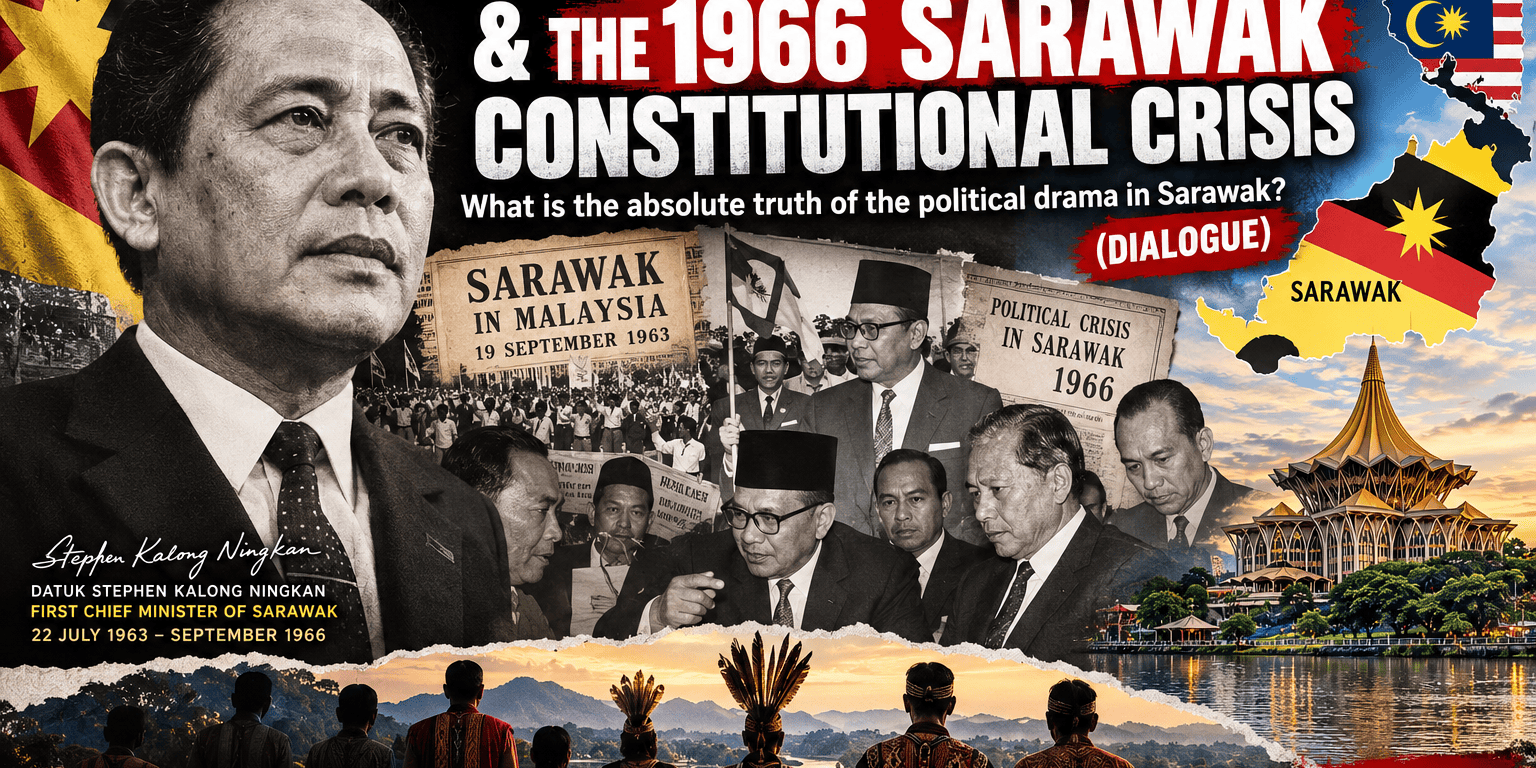
Was the removal of Stephen Kalong Ningkan merely a political struggle for power, or did it mark a turning point in Sarawak’s relationship with the federal government? More than six decades later, the events of 1966 continue to raise important questions about constitutional safeguards, political autonomy and the people’s right to determine their future.
1. Stephen Kalong Ningkan: Sarawak’s First Chief Minister
Datuk Stephen Kalong Ningkan remains one of the most significant figures in Sarawak’s political history. Born in August 1922 in Betong, he emerged as a prominent leader in the Dayak community before becoming the first Chief Minister of Sarawak.
Ningkan was among the founders of the Sarawak National Party (SNAP), established in 1961. He gained political influence through his involvement in community organisations, including the Sarawak Dayak Association, and became an important voice in the political mobilisation of Sarawak’s indigenous communities.
Following the 1962 state election, Ningkan became a leading figure in the formation of Sarawak’s first elected government. He was appointed Chief Minister on 22 July 1963, before the formation of Malaysia on 16 September 1963.
His administration operated during a turbulent period marked by debates over the terms of Malaysia’s formation, the distribution of political power and the future of Sarawak’s autonomy.
For many supporters, Ningkan represented a political leadership that was prepared to challenge decisions made in Kuala Lumpur when they believed Sarawak’s interests were at stake.
His political legacy, however, must also be understood within the wider conflicts among Sarawak’s political parties and leaders at the time.
2. The Road to the 1966 Constitutional Crisis
The political conflict surrounding Ningkan intensified during 1965 and 1966.
Disagreements developed between Ningkan and other political leaders over his administration, the composition of the state government and the direction of Sarawak’s political future.
On 16 June 1966, 21 of the 42 members of Sarawak’s Council Negri, the predecessor of today’s State Legislative Assembly, declared that they had lost confidence in Ningkan’s leadership.
The group communicated its position to Governor Tun Abang Haji Openg. Ningkan was asked to resign, but he refused. He maintained that his government’s position should be determined through the proper constitutional process in the legislature.
On 17 June 1966, the Governor purported to dismiss Ningkan and appointed Penghulu Tawi Sli as Chief Minister.
The dispute was no longer simply a disagreement between politicians. It had become a constitutional question: could the Governor dismiss a Chief Minister based on written declarations of lost confidence, without a formal vote in the legislature?
That question would become the centrepiece of the legal battle that followed. <Cite refs={[“turn828977search23″,”turn828977search2”]}/>
3. The Court Reinstated Ningkan
Ningkan challenged his dismissal in the High Court in Kuching.
On 7 September 1966, Chief Justice Harley ruled that the dismissal was invalid. The court held that the declarations submitted to the Governor did not, under the constitutional arrangements then applicable, establish the loss of confidence through the required parliamentary process.
The judgment was a significant moment in Sarawak’s constitutional history.
It demonstrated that the powers of the Governor and the procedures governing the Chief Minister’s office were subject to legal scrutiny.
Ningkan was reinstated, but his return to office did not end the political confrontation.
He sought to have the Council Negri dissolved so that the political deadlock could be resolved through an election. The federal government instead proceeded with emergency measures that changed the constitutional circumstances in Sarawak.
The court’s initial decision and the subsequent events raise an enduring question: how effectively can constitutional safeguards protect a state government when political disagreement involves both state and federal authorities? <Cite refs={[“turn828977search23″,”turn828977search26”]}/>
4. The Emergency and Ningkan’s Final Removal
On 14 September 1966, a state of emergency was proclaimed in Sarawak.
The federal government cited concerns about the political and security situation. Emergency legislation subsequently amended the relevant constitutional arrangements, enabling the Governor to convene the Council Negri under special procedures.
The Council Negri met on 23 September 1966. A vote of no confidence was passed against Ningkan, and he was removed from office again. Tawi Sli became Chief Minister.
The sequence of events remains central to debates about the constitutional crisis.
Ningkan had initially succeeded in challenging his dismissal in court. Yet emergency powers and subsequent constitutional amendments created a different legal framework under which his opponents could secure his removal.
Critics have interpreted this sequence as an example of federal intervention undermining Sarawak’s political autonomy. The federal government’s position, by contrast, relied on the constitutional validity of emergency powers and the need to resolve the political impasse.
These interpretations should be assessed against the historical record, the legislation enacted and the judgments delivered by the courts. <Cite refs={[“turn828977search23″,”turn828977search3”]}/>
5. Was the Crisis a Political Conspiracy Against Sarawak?
This remains one of the most contentious questions in discussions of Ningkan’s legacy.
Some Sarawakian accounts portray the crisis as a coordinated effort by political opponents and federal leaders to remove a Chief Minister who was asserting Sarawak’s interests.
Other interpretations emphasise dissatisfaction with Ningkan’s administration, shifting political alliances and the dispute over whether he retained the confidence of the Council Negri.
The historical record establishes that a group of 21 legislators opposed Ningkan, that the Governor dismissed him, that the High Court invalidated the initial dismissal, and that emergency legislation subsequently enabled a further vote of no confidence.
However, establishing that these events occurred does not, by itself, prove every allegation about the private motives of the individuals involved.
To determine whether there was a deliberate conspiracy, historians would need to examine contemporary correspondence, official records, parliamentary proceedings, personal accounts and other independently corroborated evidence.
The question should therefore remain open to investigation rather than being settled solely by political loyalty or ethnic identity.
Sarawak’s history deserves both courage and intellectual honesty: the courage to question established narratives and the discipline to distinguish documented facts from allegations.
6. Did the Crisis Undermine Sarawak’s Position in Malaysia?
The constitutional crisis occurred during the early years of Malaysia, when the respective powers of the federal and state governments were still being tested in practice.
Sarawak entered Malaysia under the Malaysia Agreement 1963 (MA63), alongside constitutional arrangements and safeguards intended to address the circumstances of the Borneo territories.
The crisis raised questions about the practical strength of those safeguards, particularly when state political disputes became entangled with federal interests.
Nevertheless, the 1966 crisis should not be treated as proof that MA63 automatically became invalid following Singapore’s separation in 1965.
Singapore left Malaysia on 9 August 1965, and the legal and constitutional consequences were dealt with through specific constitutional and legislative arrangements. The continuing validity and interpretation of MA63 are distinct legal questions that require examination of the relevant agreements, legislation and constitutional provisions.
For Sarawak, the more productive historical question is whether the original safeguards and division of powers have been respected in both their legal form and practical implementation.
This issue remains relevant to contemporary discussions about state rights, fiscal arrangements, natural resources and the federal relationship.
7. The Role of Dayak Political Leadership
Ningkan’s removal also forms part of a broader history of political competition among Sarawak’s indigenous communities and other political groups.
Some accounts of the crisis emphasise the role of Dayak politicians who opposed Ningkan or supported alternative leadership arrangements. Other accounts highlight the participation of non-Dayak politicians and federal leaders in the wider political struggle.
It is important not to reduce the entire crisis to a conflict between Dayak and non-Dayak communities.
Political alliances in Sarawak have historically crossed ethnic and regional boundaries. Individuals and parties made decisions for a variety of political, institutional and personal reasons, and those decisions require examination on their own evidence.
The important lesson is that political representation alone does not guarantee the protection of a community’s interests.
A leader from any ethnic group can make decisions that benefit some constituencies while disadvantaging others. Conversely, cooperation across communities can support common interests when it is based on fairness and accountability.
For Sarawak, the lasting challenge is to build institutions that protect every community rather than depend entirely on the identity or promises of individual politicians.
8. The Legal Aftermath: What Did the Courts Decide?
Ningkan continued to challenge the consequences of his second removal.
In the later proceedings, the Federal Court upheld the validity of the emergency legislation. His appeal to the Judicial Committee of the Privy Council was dismissed in 1968.
These outcomes must be distinguished from the High Court’s earlier ruling in his favour.
The first case concerned the legality of his initial dismissal under the constitutional arrangements then in force. The later proceedings concerned the emergency proclamation and the validity of the legislation that changed those arrangements.
The different outcomes demonstrate how constitutional disputes can turn on the precise legal powers available at a particular point in time.
They also explain why the crisis continues to attract legal and historical debate. Critics have questioned whether the use of emergency powers was justified by the circumstances, while the final judicial decisions upheld the legal framework used to remove Ningkan.
A complete assessment must consider both the initial judgment and the subsequent rulings, rather than presenting only the outcome that supports a preferred political interpretation. <Cite refs={[“turn828977search3″,”turn828977search4″,”turn828977search23”]}/>
9. What Can Sarawak Learn from the Ningkan Crisis?
More than 60 years later, the crisis offers several lessons for Sarawak’s political future.
First, constitutional safeguards must have practical meaning. Rights and powers written into legal documents are only effective when institutions can enforce them fairly and consistently.
Second, the state legislature must remain central to democratic accountability. Disputes over political confidence should be resolved through transparent constitutional procedures rather than informal pressure alone.
Third, emergency powers require careful scrutiny. Governments may face genuine security challenges, but extraordinary powers can also have far-reaching consequences for political institutions and civil liberties.
Fourth, political unity should not mean unquestioning loyalty. Representatives must be willing to scrutinise decisions made by their own parties, particularly when the interests of the state and its people are at stake.
Finally, historical memory must be protected through evidence. Oral histories and personal recollections can provide valuable insights, but they should be compared with official documents, contemporary reporting and court records.
The purpose of studying Ningkan is not simply to glorify one politician or condemn his opponents. It is to understand how political institutions operate under pressure and how future generations can prevent similar constitutional conflicts.
Conclusion: The Truth Must Be Bigger Than Political Allegiance
Stephen Kalong Ningkan’s removal in 1966 remains a defining episode in Sarawak’s political history.
The established facts reveal a confrontation between a Chief Minister, his political opponents, the Governor and the federal government. They also reveal a striking constitutional sequence: an initial dismissal overturned by the High Court, followed by emergency legislation, a new vote of no confidence and a final removal from office.
Whether the crisis should be understood primarily as a struggle over leadership, an exercise of federal power, or an assault on Sarawak’s autonomy remains a subject of historical interpretation.
What must not be lost is the underlying constitutional question: how can Sarawak’s institutions protect the interests of its people when political power is contested?
Ningkan’s story reminds us that political autonomy is not secured by slogans alone. It depends on effective institutions, accountable leadership and a population that understands its history.
The truth about Sarawak’s past should not belong exclusively to any political party, ethnic group or generation. It belongs to the historical record and to the people who have the right to examine it critically.
Suggested further reading
- 1966 Sarawak Constitutional Crisis — historical overview
- Constitutional Crises in the Past — Malaysiakini
- Stephen Kalong Ningkan v Government of Malaysia — judgment record
- When the Judiciary Blinked and Flinched — Sarawak Tribune
Editorial note: The article distinguishes established events and judicial outcomes from disputed allegations about political motives. Readers should consult primary documents and independent historical research when evaluating claims that go beyond the documented record.
Source : C Carrie Ngau, Pengayau Digital


Hello there.
I am C Carrie Ngau from Pengayau Digital.
Just want to inform you that this piece of article is pure legit as it is directly taken from the real source, the insider during the fall of SKN. This really is authentic fact, a real dialogue between me and the informer.
Thank you for including the credit to me.
Keep on posting and NEVER forget to include the source just in case to avoid court (-:
God bless you and your wordpress.
Good job!
LikeLike
hello sir
this site is more like a median for selective articles which i felt should be read n educate by my target readers… hence, the source has always been included with the post
if u feel that i shouldn’t do so. then, i will delete the post.
sorry for the inconvenience sir
thank u
LikeLike