
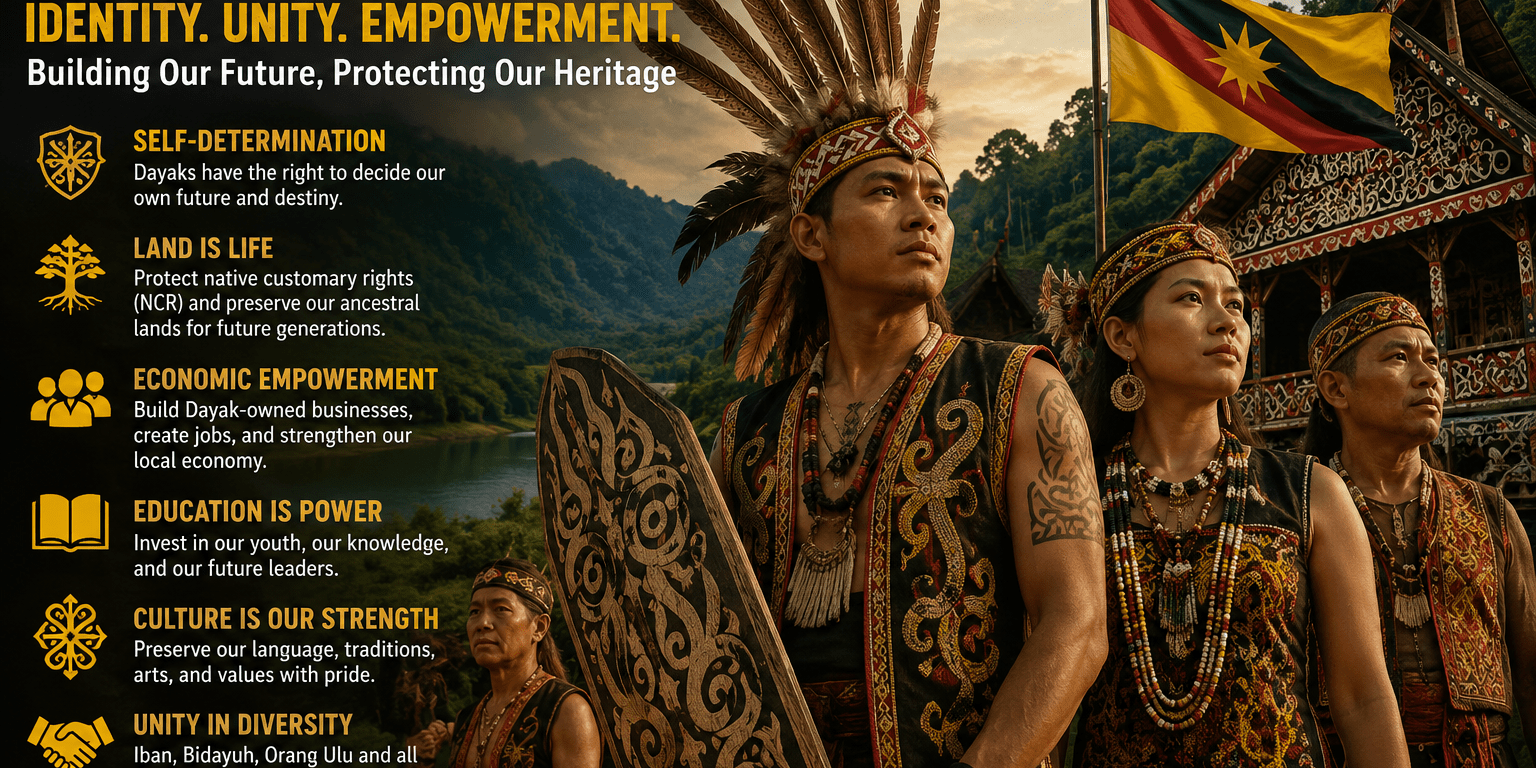
The rise of the Black Power Movement in the United States offers an important lesson for indigenous communities worldwide, including the Dayaks of Borneo. While the historical experiences are different, both movements share common themes — identity, dignity, political representation, economic empowerment, cultural preservation, and self-determination.
For the Dayak peoples of Borneo, adapting these ideas does not mean copying another struggle entirely. Instead, it means learning how a marginalized community transformed itself politically, economically, and culturally while remaining proud of its heritage.
The Dayak Reality in Modern Borneo
The Dayaks are among the indigenous peoples of Sarawak and Kalimantan. Despite being among the largest ethnic groups in Borneo, many Dayak communities continue to face challenges such as:
- Rural poverty
- Limited infrastructure
- Land rights disputes
- Migration of young talent to cities
- Weak economic ownership
- Political fragmentation
- Cultural erosion
For decades, development in Borneo has often benefited political elites and large corporations more than indigenous communities themselves. Logging, plantations, and mega-projects have transformed ancestral lands while many rural Dayaks remain economically dependent and politically divided.
This creates an important question:
Can the Dayaks shape their own future instead of merely reacting to external forces?
From Black Power to “Dayak Power”
The phrase “Black Power” emphasized self-respect, self-determination, and control over one’s destiny. A similar philosophy for the Dayaks would not be about racial supremacy or hostility toward others. Instead, it would focus on:
- Indigenous empowerment
- Economic independence
- Cultural confidence
- Educational excellence
- Political unity
- Protection of native customary rights (NCR)
“Dayak Power” would mean believing that the Dayak community must become active architects of their future rather than passive participants in political systems controlled by others.
Political Unity and Representation
One major lesson from the Black Power Movement is the importance of political organization.
The Dayaks are politically influential because of their numbers, especially in rural constituencies across Sarawak. Yet historically, Dayak political influence has often been weakened by fragmentation, party hopping, and leaders prioritizing personal interests over long-term community development.
A modern Dayak empowerment movement would require:
- Strong grassroots leadership
- Policy-driven politics
- Young educated leaders
- Independent economic thinking
- Cross-tribal unity among Iban, Bidayuh, Orang Ulu, and other Dayak groups
The goal should not be isolation from other races, but negotiating from a position of strength and confidence.
Economic Empowerment Is the Real Power
Political influence without economic strength is temporary.
The Black Power Movement understood that communities without economic ownership remain vulnerable. The same reality applies to indigenous communities in Borneo today.
Many Dayak communities possess valuable land and natural resources, yet much of the wealth generated leaves local communities. Economic empowerment could include:
- Indigenous-owned businesses
- Agricultural modernization
- Cooperative movements
- Digital entrepreneurship
- Tourism based on Dayak heritage
- Investment education
- Professional and technical training
The next generation of Dayaks cannot rely solely on government employment. True independence requires wealth creation, entrepreneurship, and ownership.
Cultural Pride and Identity
One of the greatest achievements of the Black Power era was transforming shame into pride. The movement encouraged African Americans to embrace their appearance, culture, and identity.
Similarly, Dayak identity should not be viewed as backward or rural. Dayak culture contains:
- Rich oral traditions
- Traditional ecological knowledge
- Indigenous governance systems
- Unique arts and music
- Warrior heritage
- Deep spiritual connection to the land
Modernization should not require cultural surrender.
A strong Dayak future depends on preserving languages, traditions, festivals, and indigenous knowledge while also mastering modern education, technology, and global business.
Young Dayaks should feel proud speaking their native languages, wearing traditional attire, and celebrating indigenous heritage without inferiority.
Education as the New Battlefield
In the modern world, knowledge is power.
The future struggle is no longer fought with weapons, but with:
- Education
- Technology
- Finance
- Media influence
- Political literacy
- Artificial intelligence
- Business ownership
The Dayak community must produce more:
- Engineers
- Entrepreneurs
- Lawyers
- Economists
- Scientists
- Digital creators
- Policy experts
Without intellectual and economic leadership, indigenous communities risk remaining consumers instead of decision-makers.
The Danger of Dependency Politics
One of the major criticisms often raised within indigenous communities is the culture of dependency.
Communities that depend entirely on political handouts eventually lose bargaining power. Long-term empowerment requires independent thinking and self-sustaining economic systems.
A stronger Dayak future may depend less on waiting for assistance and more on:
- Building community cooperatives
- Supporting Dayak businesses
- Investing in youth education
- Encouraging innovation
- Strengthening civil society organizations
Self-reliance creates dignity.
A Peaceful and Modern Indigenous Movement
Unlike revolutionary movements associated with violence in some parts of history, a modern Dayak empowerment movement should be democratic, peaceful, intellectual, and forward-looking.
The objective is not conflict with other ethnic groups. Borneo has long been multicultural and diverse. Instead, the mission should be:
- Equal opportunity
- Fair representation
- Protection of indigenous rights
- Sustainable development
- Shared prosperity
The strongest movements today are built through ideas, education, economics, and organization — not confrontation.
Conclusion
The Black Power Movement showed how a marginalized people could reclaim pride, identity, and political consciousness. The Dayaks of Borneo can draw inspiration from that history while creating their own path rooted in indigenous values and modern realities.
The future of the Dayaks will not be decided only in political speeches or elections. It will be decided by whether the community can build:
- Economic strength
- Educational excellence
- Cultural confidence
- Political unity
- Indigenous leadership
The real meaning of “Dayak Power” is not domination over others.
It is the courage to control one’s own destiny.
Adapted from:
- “‘Black Power’ Speech.” Dictionary of American History, The Gale Group Inc., 2003.
- Gist, Brenda Lovelace. “Eloquently Speaking.” Xlibris, December 7, 2010.
- History.com Editors. “Civil rights activist James Meredith shot.” History, A&E Television Networks, LLC, July 27, 2019.
- Walker, Samuel. “‘Black Power!’ A Slogan is Born.” Today in Civil Liberties History, Samuel Walker, 2014.
 Indie Borneo