
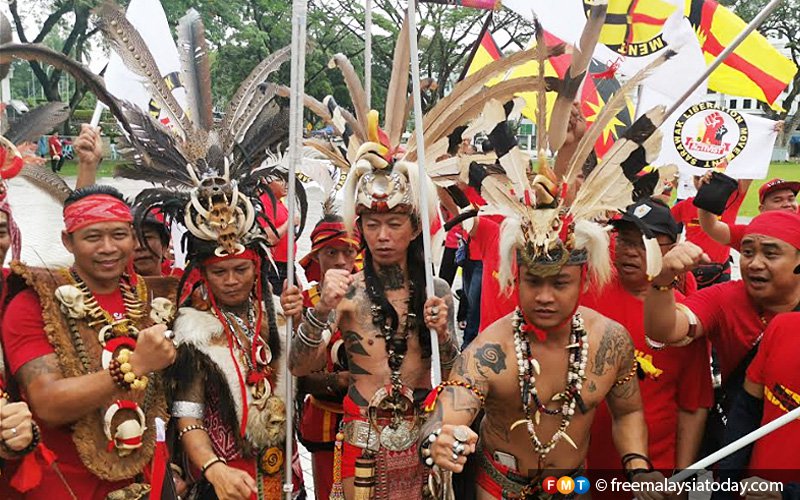
The Dayaks of Sarawak have long been regarded as the backbone of Borneo’s indigenous identity. Rich in culture, tradition, and resilience, the Dayak community has contributed immensely to the social and political fabric of the state. Yet today, many Dayaks continue to ask a difficult question: Where are we heading as a people?
For decades, concerns have been raised about poverty, rural underdevelopment, political dependency, land ownership, and the lack of economic empowerment among Dayak communities. These concerns are not new, but they remain relevant because many rural areas still lag behind in infrastructure, quality education, healthcare, and private-sector opportunities.
Rural Dependency and Political Control
One issue frequently discussed is the dependency of rural communities on government aid and political patronage. In many interior areas, government jobs remain one of the few stable employment options available. As a result, many educated Dayaks end up relying heavily on the public sector rather than building independent businesses or professional networks in the private economy.
Critics argue that this dependency weakens political courage. When livelihoods depend on government-linked systems, speaking openly against policies or leadership becomes difficult. Many feel this has created a culture where leaders are expected to “toe the line” instead of pushing aggressively for community reforms.
At the same time, it is important to recognize that many Dayak civil servants and professionals genuinely work hard for their communities within the limits of the system. Some have tried to push for change but often face structural and political obstacles.
The Question of Leadership
The debate about Dayak political leadership has existed for generations. Some believe the Dayaks, being one of the largest demographic groups in Sarawak, should unite politically and push for stronger representation at the highest levels of government, including the possibility of another Dayak Chief Minister.
Political parties such as Parti Pesaka Bumiputera Bersatu, Parti Rakyat Sarawak, Progressive Democratic Party, and Sarawak United Peoples’ Party operate within the coalition framework of Gabungan Parti Sarawak. However, some Dayak activists argue that political influence within these structures remains uneven.
The late James Jemut Masing was among the figures often associated with discussions on stronger Dayak political bargaining power. Historically, leaders like Stephen Kalong Ningkan symbolized the aspirations of many Dayaks for greater leadership representation.
Yet one major challenge remains: Dayaks themselves are diverse. The Iban, Bidayuh, Orang Ulu, and other indigenous groups do not always share the same political priorities. Internal divisions, geography, and party loyalties have often made unity difficult.
NCR Land and Economic Power
Few issues are as emotional as Native Customary Rights (NCR) land. Land is not merely property to the Dayaks — it is identity, history, inheritance, and survival.
Over the years, there have been ongoing disputes involving plantation projects, logging, and large-scale development. Many rural communities feel that NCR land has too often benefited politically connected elites and corporations rather than ordinary villagers.
While development projects can bring roads, jobs, and economic activity, critics argue that the benefits are unevenly distributed. Questions continue to arise about transparency, consent, compensation, and long-term ownership.
At the same time, some Dayak politicians and businessmen have also benefited significantly from land deals and plantation ventures. This has led to criticism that elite interests sometimes overshadow grassroots concerns.
Education and the Future Generation
Another important issue is education. Many believe that the current system still does not adequately prepare rural students for entrepreneurship, technology, or global competition.
However, there are signs of change.
Today, more young Dayaks are entering fields such as:
- engineering,
- digital business,
- law,
- academia,
- media,
- tourism,
- renewable energy,
- and entrepreneurship.
Social media and internet access are also helping younger generations become more politically aware and economically connected than before.
The future strength of the Dayak community may no longer depend entirely on politics alone. Economic independence, business ownership, digital literacy, and professional excellence could become the real tools of empowerment.
Unity Beyond Politics
The biggest challenge may not simply be about who controls power, but whether Dayaks can move beyond dependency and become more self-sustaining as a community.
Real progress requires:
- stronger education,
- economic diversification,
- protection of NCR rights,
- accountable leadership,
- youth empowerment,
- and unity of purpose.
At the same time, Sarawak’s strength has always come from cooperation among its many communities — Dayaks, Malays, Melanaus, Chinese, and others. Moving forward, reforms built on fairness and inclusion may achieve more than politics driven purely by ethnic division.
Conclusion
The question “Where are the Dayaks heading?” does not have a simple answer.
The community stands at a crossroads between tradition and modernization, dependency and independence, frustration and opportunity. While many challenges remain unresolved, the younger generation may hold the key to reshaping the future through education, entrepreneurship, and stronger civic awareness.
If Dayaks can combine unity, economic strength, and visionary leadership while preserving their cultural identity, they may not only survive the challenges ahead — they may redefine the future of Sarawak itself.
Source : Anonymous Dayak Figure
 Indie Borneo