
We often hear the phrase “practice makes perfect.” But is simply spending more hours practicing enough to become exceptional?
According to research on expertise, the answer is more complicated. The secret may not be how much you practice, but how you practice.
This is where the idea of deliberate practice becomes powerful.
What Is Deliberate Practice?
Deliberate practice is not simply repeating the same activity again and again.
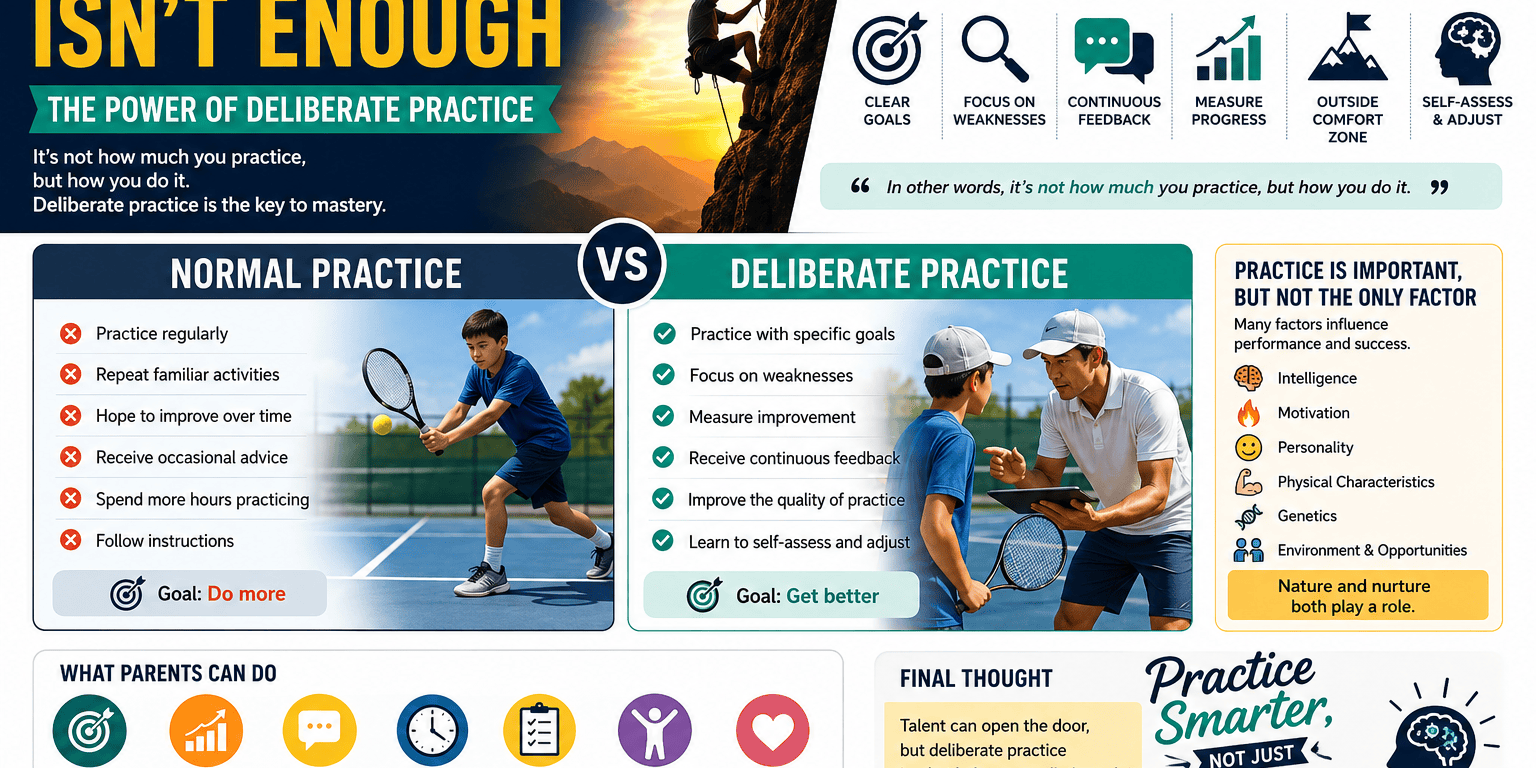
It is a structured approach to improvement that focuses on:
- Clear and specific goals
- Identifying weaknesses
- Targeted training
- Continuous feedback
- Measuring progress
- Practicing outside your comfort zone
- Developing strong concentration and self-awareness
For example, a person who wants to become better at tennis could play matches every day. That is practice.
However, deliberate practice would involve identifying a specific weakness—such as a poor forehand—and repeatedly working on that weakness with targeted exercises, feedback, and measurable goals.
The difference is simple: ordinary practice repeats. Deliberate practice improves.
The 10,000-Hour Myth
Many people believe that becoming an expert simply requires 10,000 hours of practice.
However, the idea has often been oversimplified.
Spending thousands of hours doing something inefficiently does not guarantee exceptional results. A person can repeat the same mistakes for years without making significant progress.
Focused practice is more valuable than unfocused repetition.
Instead of asking:
“How many hours have I practiced?”
A better question is:
“What did I improve during my practice today?”
Why Feedback Matters
One of the most important parts of deliberate practice is feedback.
A good teacher, coach, or mentor can identify mistakes that we may not notice ourselves. They can also design specific exercises to help us improve.
However, the ultimate goal is not to become dependent on a coach forever.
Over time, a person should learn to:
- Assess their own performance
- Recognise weaknesses
- Set personal goals
- Adjust their training
- Develop better strategies independently
This ability to self-assess can be valuable not only in sports or music, but also in school, business, and professional life.
Practice Outside Your Comfort Zone
Improvement rarely happens when everything feels easy.
Deliberate practice requires working on tasks that are challenging but still achievable.
If a task is too easy, there is little room for growth. If it is too difficult, frustration can destroy motivation.
The best learning happens when you consistently push yourself slightly beyond your current ability.
This could mean:
- A musician learning a more difficult piece
- A student tackling harder problems
- A writer improving a weak area of their writing
- A salesperson practising difficult conversations
- An athlete focusing on their weakest skill
Growth happens when you intentionally work on what you cannot yet do well.
Can Hard Work Make Anyone a Champion?
This is where the debate becomes interesting.
Deliberate practice can dramatically improve performance, but practice may not be the only factor that matters.
Research and criticism surrounding the theory of deliberate practice suggest that other factors can also influence success, including:
- Intelligence
- Motivation
- Personality
- Physical characteristics
- Genetics
- Environment and opportunities
This does not mean practice is unimportant.
It means that success is usually the result of multiple factors working together.
Not everyone who practices soccer will become a world-class professional. Not everyone who studies music will become the next Mozart.
But almost everyone can improve significantly by learning how to practice effectively.
What Parents Can Learn
For parents, the most important lesson is not to force children to become world champions.
The goal should be to help children develop the skill of improvement itself.
Parents can encourage children to:
1. Set Specific Goals
Instead of saying, “Get better at math,” try:
“Improve your ability to solve fractions.”
Specific goals create a clearer direction for improvement.
2. Focus on Weaknesses
Children should not only practice what they already enjoy or do well.
Improvement often comes from identifying weaknesses and working on them deliberately.
3. Learn to Accept Feedback
Constructive feedback can sometimes feel uncomfortable.
However, learning to listen, adjust, and improve is an important life skill.
4. Avoid Simply Adding More Hours
More practice is not always better.
A shorter session with full concentration may be more effective than several hours of distracted repetition.
5. Let Children Take Responsibility
Eventually, children should learn to direct their own development.
The strongest motivation often comes when a child chooses a passion and takes ownership of the work required to improve.
Normal Practice vs Deliberate Practice
Here is the difference:
| Normal Practice | Deliberate Practice |
|---|---|
| Practice regularly | Practice with specific goals |
| Repeat familiar activities | Focus on weaknesses |
| Hope to improve over time | Measure improvement |
| Receive occasional advice | Receive continuous feedback |
| Spend more hours practicing | Improve the quality of practice |
| Follow instructions | Learn to self-assess and adjust |
The goal is not simply to do more.
The goal is to improve more intelligently.
Practice Smarter, Not Just Harder
The most valuable lesson from the science of expertise is that improvement is a process.
You do not need to become perfect overnight.
Small, focused improvements can build over time.
A better approach is to ask yourself every day:
- What am I trying to improve?
- What is my biggest weakness?
- How can I measure my progress?
- What feedback do I need?
- What should I practise differently tomorrow?
Success is rarely created through one massive effort.
It is built through small, intentional improvements repeated over time.
Final Thoughts
Talent can matter. Opportunity can matter. Motivation and personal characteristics can matter.
But one thing remains within our control:
How deliberately we work to improve.
The people who make the greatest progress are not always those who simply spend the most time working.
They are often the people who learn from mistakes, focus on weaknesses, seek feedback, measure progress, and continuously challenge themselves.
So the next time you practise something, remember:
Don’t just practice harder. Practice smarter.
That may be the difference between simply spending time on a skill—and truly mastering it.
Source : https://qz.com/
 Indie Borneo