
Building wealth is not about getting rich overnight. It is about making smart financial decisions today that will reward you in the future. One of the simplest yet most effective tools every investor should understand is the Rule of 72. This easy-to-remember rule helps you estimate how long it will take for your investment to double, making it an excellent guide for planning your financial future.
Why Investing Requires Sacrifice
Every investment begins with a choice. Money invested today cannot be spent on entertainment, shopping, or other short-term pleasures. This concept is known as delayed gratification—giving up some current consumption in exchange for greater financial security in the future.
Many people find it difficult to reduce their spending habits, but successful investors understand that small sacrifices today can create significant wealth over time.
Retirement Planning Is More Important Than Ever
People are living longer than previous generations, which means retirement savings need to last much longer. Depending solely on children or family members for financial support is becoming less practical.
To maintain your lifestyle after retirement, your investment income should ideally replace most, if not all, of your previous monthly income. The earlier you start investing, the more time your money has to grow through the power of compounding.
Understanding the Rule of 72
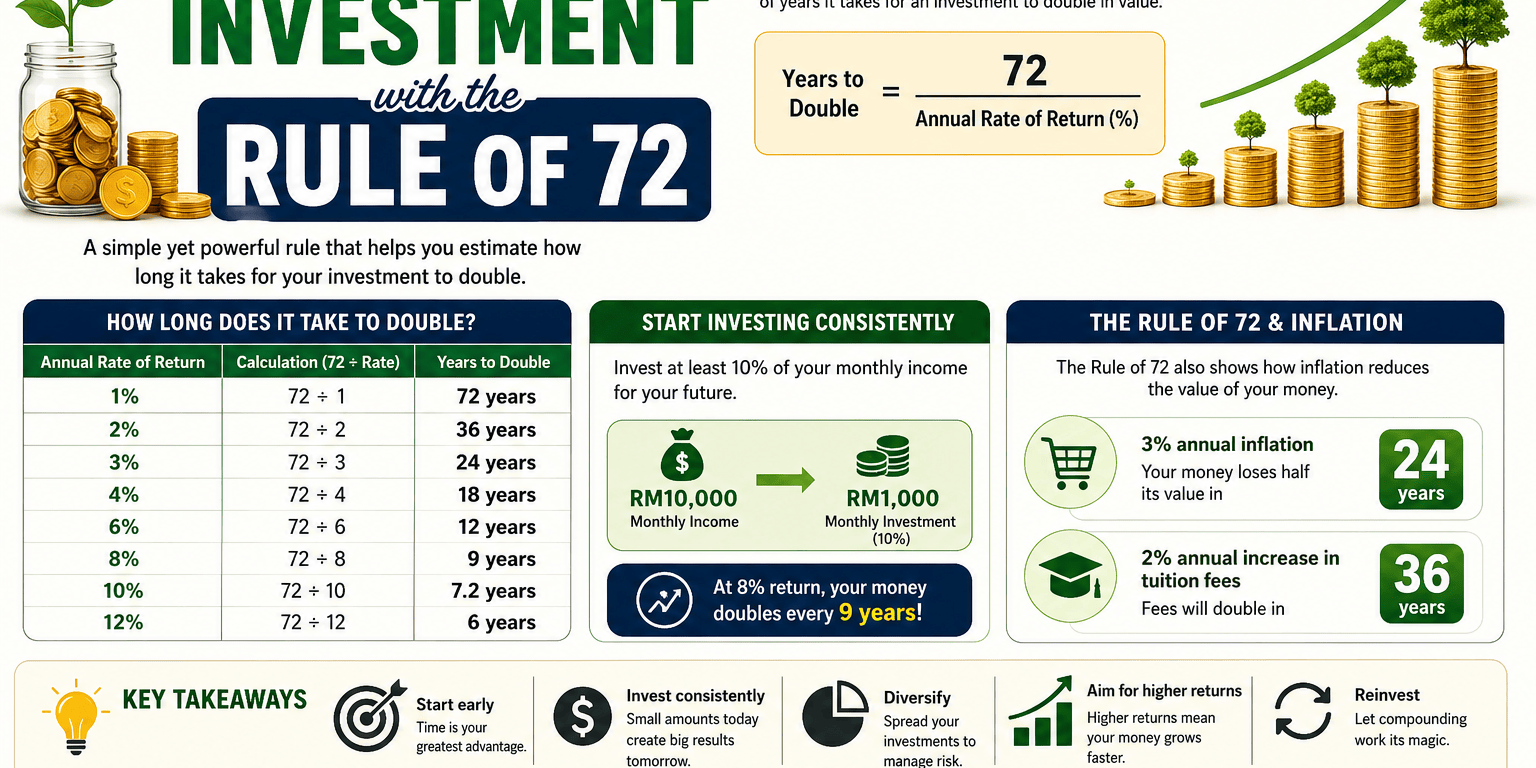
The Rule of 72 is a simple formula used to estimate how many years it takes for an investment to double.
Formula:
Years to Double = 72 ÷ Annual Rate of Return (%)
Examples
- 8% annual return: 72 ÷ 8 = 9 years
- 6% annual return: 72 ÷ 6 = 12 years
- 4% annual return: 72 ÷ 4 = 18 years
- 1% annual return: 72 ÷ 1 = 72 years
The higher your annual return, the faster your investment grows.
Start Investing Consistently
A practical strategy is to invest at least 10% of your monthly income.
For example:
- Monthly income: RM10,000
- Monthly investment: RM1,000
If your investments earn an average annual return of 8%, your money will approximately double every 9 years. Over several decades, this compounding effect can significantly increase your retirement savings.
The Rule of 72 Also Explains Inflation
The Rule of 72 is not only useful for investments—it also demonstrates how inflation reduces your purchasing power.
For example:
- 3% annual inflation means the value of your money is effectively cut in half in about 24 years.
- 2% annual tuition fee increases mean education costs will roughly double in 36 years.
This is why simply saving money in a low-interest account may not be enough. Your investments should aim to generate returns that exceed the rate of inflation.
Build a Strong Investment Strategy
The Rule of 72 is most effective when combined with sound investment principles:
- Define clear financial goals.
- Understand your personal risk tolerance.
- Invest consistently over the long term.
- Diversify your portfolio across different asset classes.
- Reinvest your returns to maximize compounding.
Successful investing is not about chasing quick profits—it is about allowing time and compound growth to work in your favor.
Final Thoughts
The Rule of 72 is one of the easiest financial concepts to understand, yet it provides powerful insights into wealth creation. It helps investors appreciate the value of higher investment returns, the importance of starting early, and the hidden cost of inflation.
Remember, time is your greatest investment partner. The sooner you begin investing consistently, the greater the benefits of compound growth. Combined with disciplined saving, diversification, and a long-term mindset, the Rule of 72 can become a valuable guide on your journey toward financial independence.
Shella Georgina Beatrice is a lecturer from the School of Business, Faculty of Business, Design and Arts at Swinburne University of Technology Sarawak Campus.
Source : Borneo Post by Shella Georgina Beatrice
 Indie Borneo