
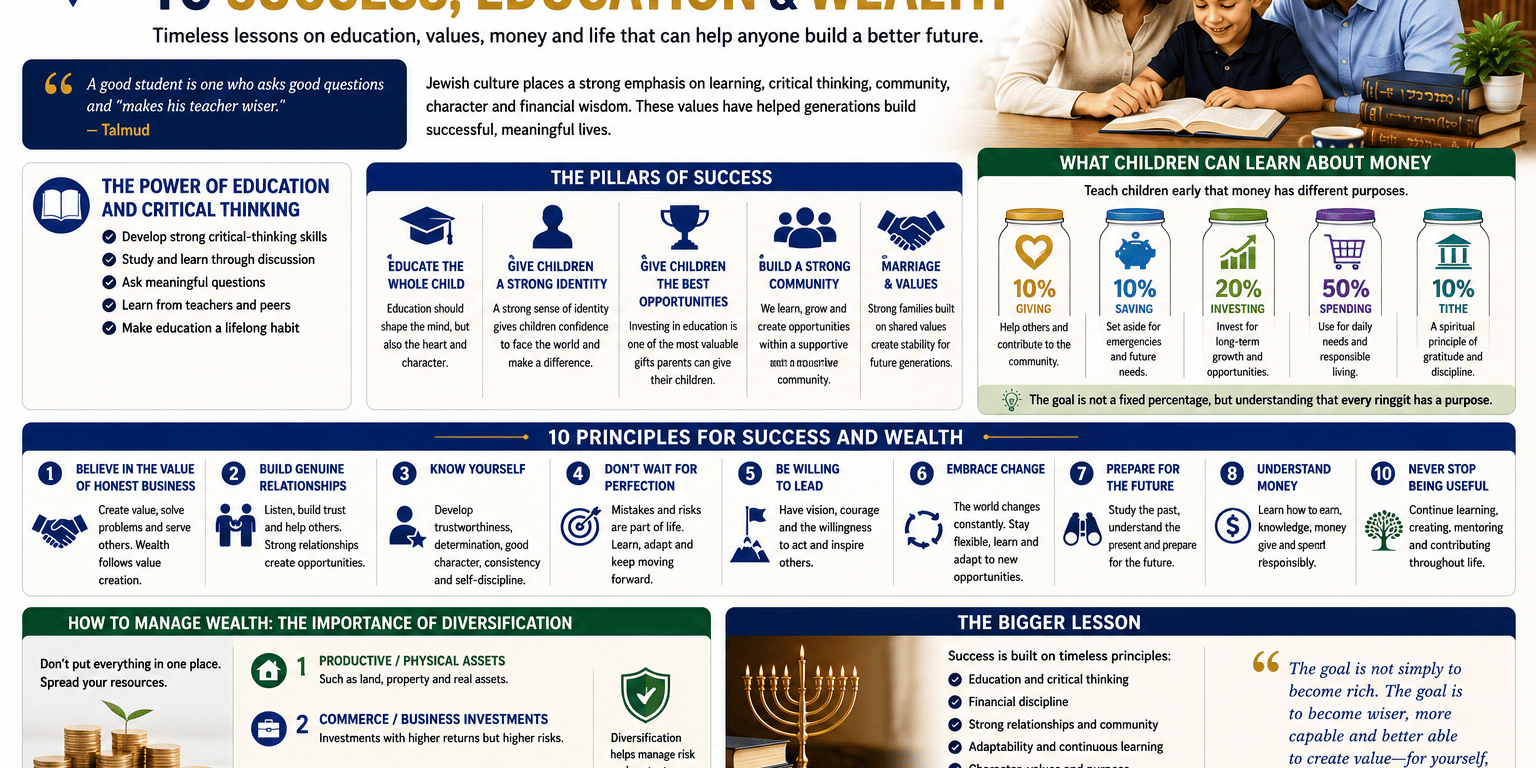
What Can We Learn From a Culture That Values Education?
There is no doubt that education, discipline, community and lifelong learning can play an important role in personal success. Jewish traditions place strong emphasis on these values, making them an interesting source of lessons about parenting, financial education, business and personal development.
If you struggle with money or want to build a more successful life, perhaps the most valuable lesson is this: the choices we make and the knowledge we develop can shape our future—and the future of our children.
So, what can we learn from Jewish educational and cultural traditions?
The Power of Education and Critical Thinking
For centuries, Jewish culture has placed a strong emphasis on literacy, study and discussion. Traditional learning encourages people not simply to memorize information, but also to ask questions, debate ideas and develop critical-thinking skills.
Some of the key practices highlighted in Jewish learning include:
- Developing strong critical-thinking skills
- Studying and learning through discussion
- Asking meaningful questions
- Learning from teachers and fellow students
- Making education a lifelong habit
A good education is not just about preparing someone for a job. It can also help develop character, judgment, confidence and the ability to solve problems.
The Pillars of Success
Several important principles stand out.
1. Educate the Whole Child
Education should go beyond academic knowledge. Children also need to develop ethics, confidence, discipline and a sense of purpose.
2. Give Children a Strong Identity
A strong sense of identity can help children face challenges with greater confidence. Knowing where you come from and what values you believe in can provide direction in life.
3. Give Children the Best Possible Opportunities
Investing in education can be one of the most valuable gifts parents give their children. Knowledge and skills can stay with a person throughout life.
4. Build a Strong Community
We do not succeed completely alone. Friends, mentors, family and community can provide knowledge, opportunities, encouragement and support.
What Children Can Learn About Money
Financial education is another important lesson. Children who learn about money early may develop better financial discipline as adults.
A simple approach is to teach children that money can have different purposes:
- Giving — helping others and contributing to the community
- Saving — preparing for emergencies and future needs
- Investing — putting money to work for long-term growth
- Spending — managing everyday needs and wants
The important lesson is not necessarily to follow one fixed percentage or system. Instead, children should understand that every ringgit has a purpose.
Learning to save, give, invest and spend responsibly can build financial awareness from an early age.
10 Principles for Success and Wealth
1. Believe in the Value of Honest Business
Business should create value. When you provide a useful product or service, you solve problems for other people.
Success should not simply be about making money. It should also be about creating something useful and serving others.
2. Build Genuine Relationships
Your network can create opportunities, but relationships should be genuine.
Take an interest in people. Listen to them. Build trust before expecting anything in return.
The strongest relationships are not based only on asking, “What can you do for me?” They are also based on asking, “How can we help each other?”
3. Know Yourself
Understanding yourself can make you more effective.
Develop qualities such as:
- Trustworthiness
- Determination
- Good character
- Consistency
- Self-discipline
People are more likely to work with and trust someone who is reliable and knows what they stand for.
4. Don’t Wait for Perfection
Life, business and investing will never be perfect.
There will always be risks, mistakes and unexpected problems. Instead of waiting for the perfect moment, learn from mistakes, adapt and continue moving forward.
Progress is often more important than perfection.
5. Be Willing to Lead
Leadership begins with action.
A good leader needs:
- Vision — understanding the bigger picture
- The ability to follow — learning from others
- Courage — standing by important principles
- The willingness to act — taking responsibility when opportunities arise
Leadership is not simply a title. It is the ability to create direction and inspire others.
6. Embrace Change
The world constantly changes.
Industries change. Technology changes. Markets change. People change.
Those who refuse to adapt may struggle when circumstances shift. Keep learning, remain flexible and be willing to replace outdated ideas with better ones.
Change can be uncomfortable, but it can also create opportunity.
7. Prepare for the Future
Successful planning requires looking beyond today.
Ask yourself:
- What risks could affect my life?
- What would happen if I lost my job?
- What lessons can I learn from history?
- What patterns are repeating?
- What skills do I need for the future?
Knowledge of the past, awareness of the present and preparation for the future can lead to better decisions.
8. Understand Money
Money should be understood as a tool.
It can be used to meet needs, create opportunities, build businesses, support families and help other people.
Financial intelligence means learning how to:
- Earn
- Save
- Invest
- Protect
- Give
- Spend responsibly
The more you understand how money works, the better prepared you may be to make thoughtful financial decisions.
9. Give Back
Success is not only about what you keep. It is also about what you contribute.
Giving can take many forms:
- Money
- Time
- Knowledge
- Mentorship
- Help for people in need
Small acts of generosity can strengthen relationships and communities.
10. Never Stop Being Useful
Retirement does not necessarily mean that a person should stop contributing.
Work can mean more than having a job. Teaching, creating, mentoring, volunteering and helping others are also ways of adding value.
Continue learning. Continue creating. Continue contributing.
A meaningful life is often built around having a purpose and being useful to others.
How to Manage Wealth: The Importance of Diversification
One of the most interesting financial principles discussed in traditional teachings is the importance of not putting everything in one place.
The basic idea is simple: divide your resources so that one unexpected event does not destroy everything.
The source describes a three-part approach:
- Productive or physical assets — such as land or property
- Commerce or business investments — investments with potential for higher returns and higher risks
- Cash or liquid reserves — money available for emergencies and opportunities
The modern lesson is clear: diversification can help manage risk.
Rather than placing all your money into one investment, consider spreading risk across different types of assets based on your personal goals, risk tolerance and financial situation.
The Bigger Lesson
The most important lesson is not that any one culture has a magical secret to wealth.
Instead, success can be built on principles such as:
Education. Critical thinking. Financial discipline. Strong relationships. Adaptability. Character. Community. Long-term planning.
Teach children to ask questions.
Encourage them to read and learn.
Help them understand money.
Support their curiosity.
Teach them to build meaningful relationships and contribute to others.
Final Thought
Knowledge is one of the few investments that can continue to grow throughout your life.
Be ambitious about learning. Keep improving your skills, understanding the world and preparing for the future.
The goal is not simply to become rich. The goal is to become wiser, more capable and better able to create value—for yourself, your family and your community.
 Indie Borneo