
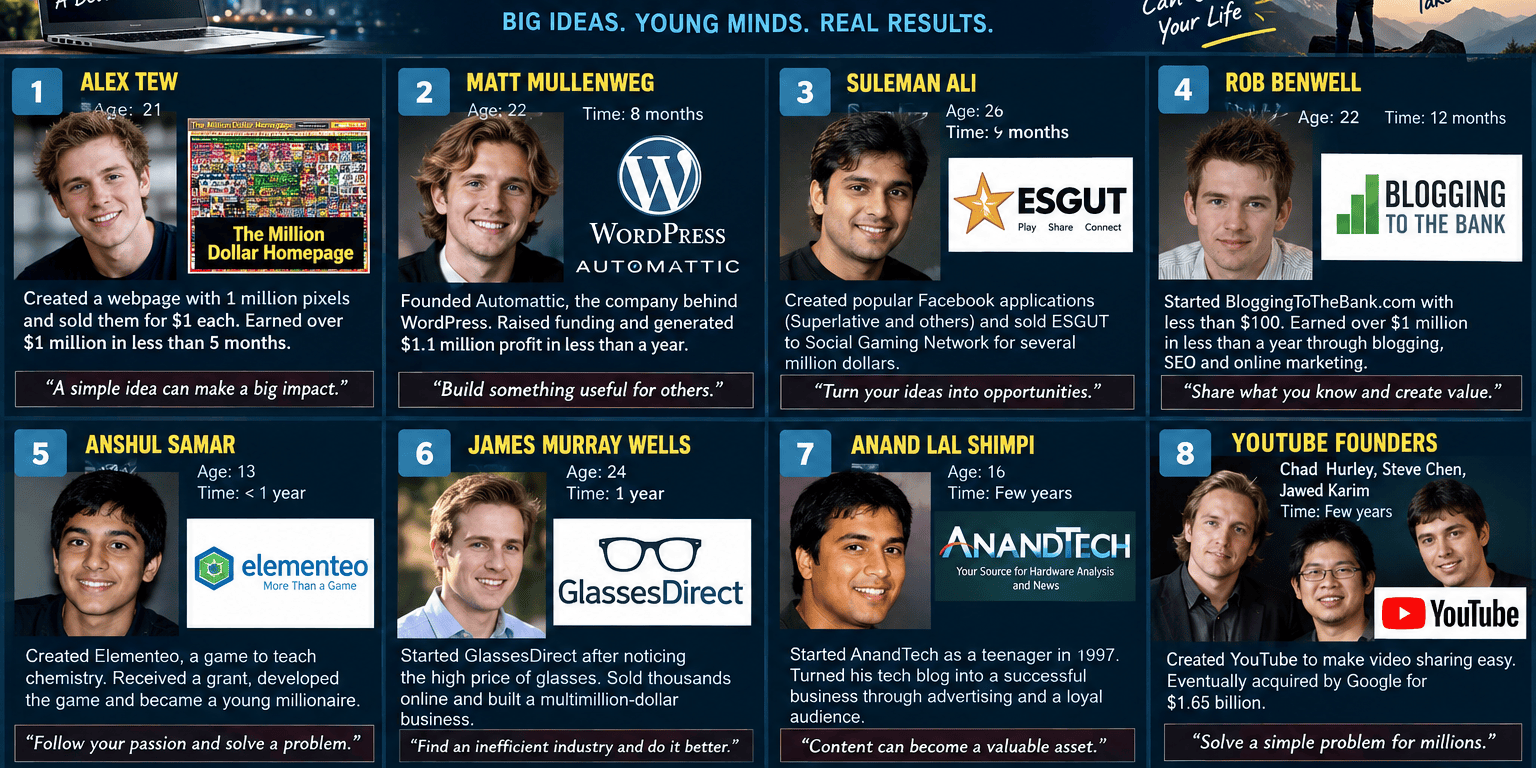
The internet has created opportunities for ordinary people to build businesses from ideas that initially seemed simple—or even strange. Some young entrepreneurs turned websites, blogs, games and online services into businesses worth millions.
Their stories demonstrate an important principle: a successful online business does not always begin with a huge amount of money. Sometimes it begins with an unusual idea, persistence and the ability to attract an audience.
1. Alex Tew — The Million Dollar Homepage
At just 21, Alex Tew was a student at the University of Nottingham looking for a way to finance his education without taking out a student loan.
His idea was remarkably simple: create a webpage containing one million pixels and sell advertising space on those pixels.
The Million Dollar Homepage divided the page into blocks of pixels, selling them for $1 per pixel, with a minimum purchase of 100 pixels. Advertisers received image-based links that directed visitors to their websites.
Tew launched the website in August and initially relied on word-of-mouth promotion. After a BBC journalist noticed the project, it rapidly attracted attention.
Eventually, the final 1,000 pixels were auctioned on eBay. According to the source material, the project generated more than $1 million in gross revenue in less than five months.
Lesson: A simple idea can become valuable when it creates scarcity and attracts massive attention.
2. Matt Mullenweg — WordPress and Automattic
Matt Mullenweg was only 22 when he founded Automattic, the company behind WordPress.com and other web services.
Mullenweg was already involved in developing WordPress, an open-source content-management system that eventually became one of the most widely used platforms on the internet.
His story demonstrates the power of building something useful for a large community.
Instead of simply creating a website for himself, he helped develop a platform that allowed millions of other people to publish their own websites.
Lesson: Building infrastructure that helps other people create can become a powerful business model.
3. Rob Benwell — Blogging to the Bank
Rob Benwell focused on blogging, search engine optimization and website monetization.
He reportedly started with less than $100 and created BloggingToTheBank.com, where he taught people how to make money from blogging and search marketing.
He also developed educational products and books around online marketing.
Lesson: You don’t necessarily have to sell physical products online. Knowledge, education and digital products can also become businesses.
4. Anshul Samar — Learning Through Games
Anshul Samar started developing Elementeo, a game designed to teach chemistry through play.
The idea came from his interest in games and a desire to demonstrate that games could also have educational value.
He obtained a small grant, developed prototypes and eventually launched the game.
The story illustrates how an individual’s personal interest can be transformed into a product with a specific audience.
Lesson: Look for problems or disagreements around you and ask whether you can create a product that solves them.
5. James Murray Wells — GlassesDirect
James Murray Wells noticed a huge difference between the price consumers paid for glasses and their manufacturing cost.
He also noticed that online competition in the market was limited at the time.
That observation led him to create GlassesDirect.
The company sold thousands of pairs of glasses and eventually became a multimillion-dollar business.
Lesson: Sometimes the opportunity is not to invent something completely new, but to find an inefficient industry and offer consumers a better deal.
6. Anand Lal Shimpi — Turning a Tech Blog Into a Business
Anand Lal Shimpi started AnandTech as a teenager in 1997.
The website focused on computer hardware and technology. As its readership grew, advertising revenue turned the website into a substantial business.
This is one of the clearest examples of how content itself can become a business asset.
A person does not necessarily need to manufacture a product. Building an audience around valuable information can create opportunities for advertising, sponsorships, affiliate marketing and digital products.
Lesson: An audience can become an asset when you consistently provide useful information.
7. Ephren Taylor — From Video Games to Online Business
Ephren Taylor became interested in creating video games when he was young.
He taught himself programming and eventually created products that he could sell.
Later, he helped establish a job-posting website aimed at students.
His story shows the potential of learning technical skills early and applying them to practical problems.
Lesson: Skills such as programming, design, marketing and writing can become entrepreneurial tools.
8. The YouTube Founders — Solving a Simple Problem
Chad Hurley, Steve Chen and Jawed Karim were former PayPal employees who recognized a problem: sharing video clips online was difficult.
They developed YouTube as a video-sharing platform.
The service attracted investment, rapidly grew its audience and was eventually acquired by Google for $1.65 billion.
Lesson: Some of the biggest businesses begin by solving an everyday problem that millions of people experience.
What These Stories Have in Common
Although these entrepreneurs built very different businesses, several patterns appear repeatedly.
1. Start with a simple problem
The opportunity does not always have to be revolutionary.
Ask:
What frustrates people?
What takes too much time?
What costs too much money?
What is difficult to find?
A good business can begin with a straightforward answer to one of these questions.
2. Build an audience
An audience can be more valuable than the initial product.
Blogs, YouTube channels, social-media pages, newsletters and online communities can all create an audience that later supports multiple sources of income.
3. Use the internet for leverage
A traditional business may require a physical shop, employees and significant capital.
An internet business can sometimes start with:
- A laptop
- A website
- A useful skill
- Content
- Social media
- Digital products
- Online marketplaces
The internet allows one person to reach customers far beyond their local area.
4. Look for unconventional opportunities
The Million Dollar Homepage is a perfect example.
Selling pixels sounds almost absurd at first.
But the idea created something advertisers wanted: limited advertising space on a website that was attracting attention.
The lesson is not to copy the exact idea. The lesson is to question conventional assumptions.
5. Turn knowledge into products
Blogging, teaching, consulting, courses, ebooks, templates and software can all transform knowledge into income.
You don’t necessarily need to invent a physical product.
Sometimes what you know can become what you sell.
The Modern Version
The internet has changed considerably since many of these businesses were created.
Today, entrepreneurs can combine:
AI + Content + Social Media + Digital Products + E-commerce
For example, one person could create a niche website, produce articles and videos, develop downloadable templates, build an email audience and sell digital products globally.
The technology is different, but the underlying principle remains the same:
Find a problem, create something useful, attract attention and turn that attention into value.
The biggest opportunity may not be copying yesterday’s internet millionaires.
It may be discovering what people will need tomorrow.
Final Thought
The stories of these young entrepreneurs show that wealth creation on the internet can come from many different directions: advertising, software, blogging, education, e-commerce, games and online communities.
There is no guaranteed formula for becoming a millionaire.
But there is a repeatable process worth studying:
Identify a problem → create a solution → build an audience → monetize the value → reinvest and grow.
For today’s aspiring entrepreneur, the question is not simply:
“How can I make money online?”
A better question is:
“What valuable thing can I create that people will willingly pay for?”
____________________________________________________________
Source : http://brainprick.com/fastest-internet-millionaires/

