
For years, parenting advice has celebrated the strict discipline of Asian “Tiger Moms” and the relaxed confidence of French parents. But another parenting tradition offers valuable lessons: the Jewish approach to raising children.
Jewish communities make up a very small percentage of the world’s population, yet Jewish individuals have made significant contributions to science, literature, film, medicine and other fields. This raises an interesting question: what parenting values may help children become curious, creative, independent and successful?
According to the ideas explored in Mamaleh Knows Best by Marjorie Ingall, several traditions stand out.
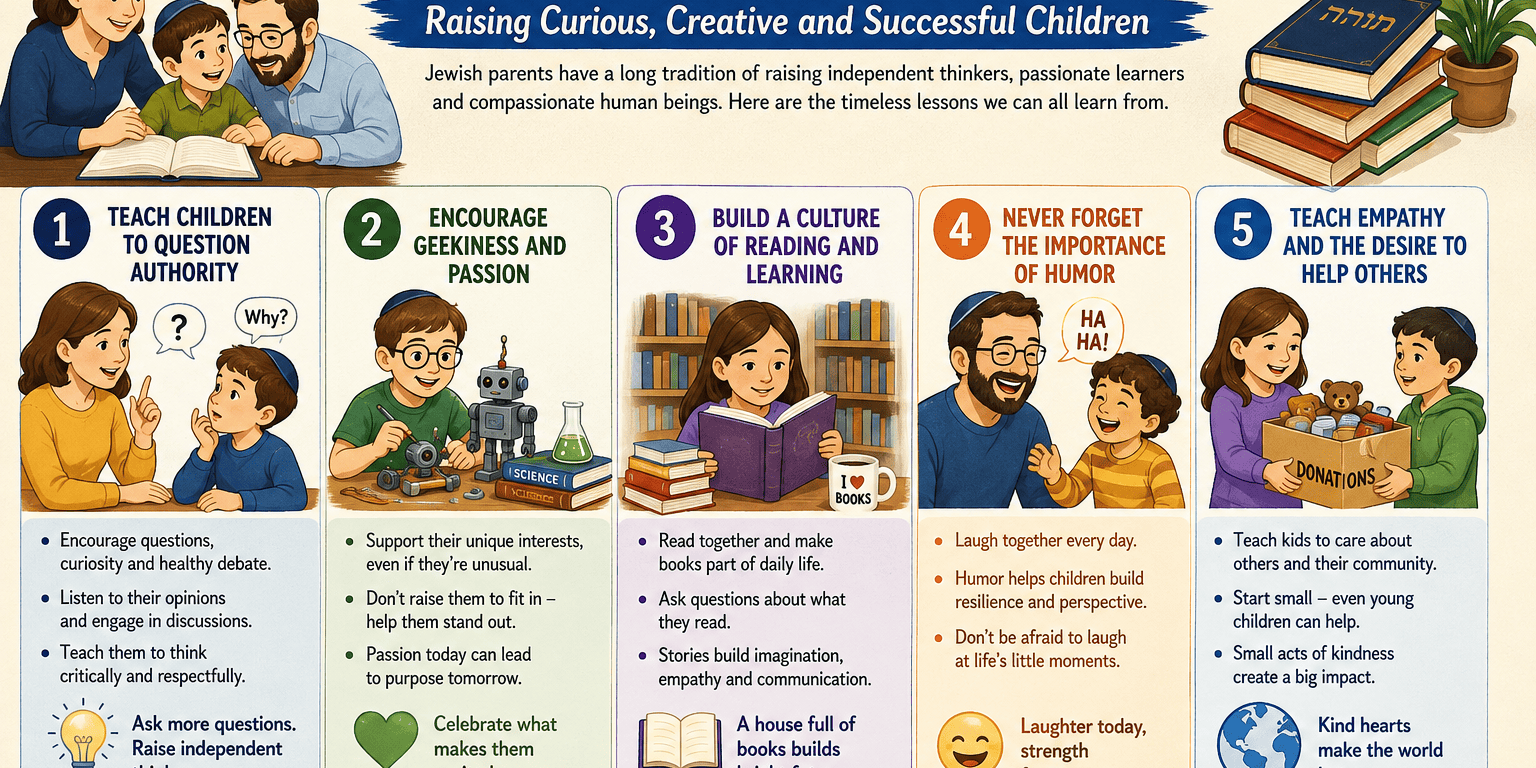
1. Teach Children to Question Authority
One of the strongest traditions in Jewish learning is debate. Children are encouraged not simply to accept an answer because it comes from a teacher, parent or authority figure.
This does not mean encouraging disrespect. Instead, it means teaching children to ask:
- Why?
- How do we know this is true?
- Is there another way to look at this?
- Does this answer make sense?
Parents can encourage healthy debate by asking children for their opinions and listening carefully to their reasoning. When children learn to question assumptions respectfully, they develop stronger critical-thinking and problem-solving skills.
2. Encourage Geekiness and Passion
Success does not always come from being popular or fitting in. Children should feel comfortable exploring the subjects and activities that genuinely excite them.
Whether a child loves mathematics, science, books, computers, history, art or another unusual interest, parents can support that passion instead of forcing the child to follow what everyone else is doing.
The lesson is simple: do not raise children to be copies of others. Help them discover what makes them curious.
3. Build a Culture of Reading and Learning
Books, stories and discussion can open a child’s mind to new ideas and experiences. Parents can encourage reading by reading themselves, reading with their children and making interesting books easily available at home.
Instead of treating reading as a punishment or school assignment, parents can help children discover stories they genuinely enjoy.
After reading, ask questions such as:
- What did you think about the story?
- Why do you think the character made that decision?
- What would you have done differently?
These conversations can help children develop imagination, communication skills and independent thinking.
4. Never Forget the Importance of Humor
Humor can help children become more resilient. Life is not always easy, and the ability to laugh can help people cope with challenges and maintain perspective.
Families do not need to be perfect. Sharing jokes, funny stories and laughter can create strong emotional connections between parents and children.
A child who learns to laugh at mistakes may also become less afraid of failure.
5. Teach Empathy and the Desire to Help Others
Achievement alone should not be the ultimate goal of parenting. Children should also learn to understand the feelings of others and contribute to their communities.
Small acts can teach powerful lessons:
- Donating old toys or clothes
- Helping an elderly neighbour
- Supporting someone who is struggling
- Volunteering as a family
- Showing kindness to classmates
Children do not need to perform extraordinary acts to make a difference. Small acts of kindness can have a powerful impact.
The Bigger Lesson
The most valuable lesson from Jewish parenting may not be a specific rule. It is a combination of values: curiosity, learning, debate, individuality, humor and empathy.
Parents do not need to copy another culture perfectly. Instead, they can borrow useful principles and adapt them to their own families.
Encourage your children to ask questions. Let them explore their passions. Fill their lives with books, conversations and laughter. Teach them that being different is not something to hide. Most importantly, teach them that success is not only about personal achievement, but also about understanding and helping others.
In the end, raising successful children may have less to do with creating perfect students and more to do with raising curious minds, independent thinkers, passionate learners and compassionate human beings.
Source : Chicago Tribune by Nara Schoenberg
 Indie Borneo