

Throughout history, Jewish communities have made remarkable contributions to science, medicine, economics, literature, music, and technology. Despite representing a small percentage of the global population, Jewish individuals have been recognized with a disproportionately high number of prestigious awards, including Nobel Prizes. This has prompted researchers to ask an intriguing question:
Why have Jewish communities produced so many high achievers?
The answer is far more complex than genetics alone. Modern research suggests that culture, education, family values, and historical circumstances all play important roles.
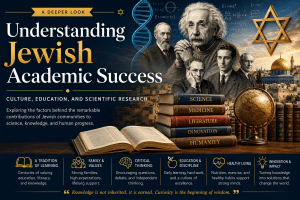
A Strong Tradition of Learning
One of the most widely accepted explanations is the long-standing Jewish emphasis on education.
For centuries, Jewish culture has encouraged literacy, critical thinking, and lifelong learning. Children are taught to ask questions, debate ideas, and seek evidence rather than simply memorizing information.
This educational tradition extends beyond religious studies into mathematics, science, medicine, law, and business.
Parents often invest significant time and resources into their children’s education, believing that knowledge is one of life’s greatest assets.
A Culture That Encourages Critical Thinking
Jewish education is well known for encouraging discussion and questioning.
Rather than expecting students to accept information without challenge, many educational settings encourage:
- Asking thoughtful questions
- Examining different viewpoints
- Solving complex problems
- Developing independent thinking
These habits are valuable not only in academics but also in entrepreneurship, research, and innovation.
Historical Circumstances
History also played an important role.
For centuries, Jewish communities often faced restrictions on owning land or entering certain professions. As a result, many pursued occupations requiring literacy and analytical skills, including:
- Finance
- Commerce
- Law
- Medicine
- Scholarship
These professions rewarded education and intellectual development across many generations.
Scientific Research on Genetics
Some researchers have explored whether genetics may have contributed to cognitive differences among certain Jewish populations, particularly Ashkenazi Jews.
Gregory Cochran and Henry Harpending proposed a controversial hypothesis suggesting that historical selection pressures may have influenced certain inherited traits alongside some genetic disorders found more commonly among Ashkenazi Jews.
However, this theory remains controversial.
Most geneticists agree that:
- Intelligence is influenced by thousands of genes.
- No single “intelligence gene” exists.
- Environment plays an equally important role.
Today, there is no scientific consensus that genetics alone explains Jewish academic success.
The Importance of Family
Many successful families—regardless of ethnicity—share similar characteristics:
- Reading from an early age
- High expectations
- Consistent encouragement
- Structured learning
- Curiosity and exploration
- Respect for education
Parents who actively participate in their children’s learning often help create environments where academic achievement can flourish.
Nutrition and Healthy Living
Proper nutrition supports brain development in all children.
Research supports consuming:
- Fish rich in omega-3 fatty acids
- Fruits and vegetables
- Whole grains
- Nuts
- Adequate protein
- Balanced diets
Healthy habits such as regular exercise, sufficient sleep, and avoiding smoking also contribute to better cognitive health.
However, many claims found online—such as particular meal orders, avoiding fish heads, or specific food combinations making children smarter—are not supported by strong scientific evidence.
Music, Mathematics, and Sports
Research suggests that children benefit from activities such as:
- Learning musical instruments
- Practicing mathematics
- Participating in sports
- Reading regularly
- Playing strategic games like chess
These activities strengthen concentration, discipline, creativity, and problem-solving skills.
While they may not directly increase IQ, they help develop important cognitive abilities and lifelong learning habits.
Intelligence Is Multifactorial
Modern science views intelligence as the product of many interacting factors, including:
- Genetics
- Prenatal health
- Nutrition
- Quality of education
- Family environment
- Socioeconomic opportunities
- Motivation
- Persistence
- Access to learning resources
Success is rarely determined by any single factor.
Lessons Anyone Can Apply
The encouraging news is that many of the practices associated with high academic achievement are accessible to everyone:
- Foster a love of reading.
- Encourage curiosity and thoughtful questions.
- Prioritize quality education.
- Maintain a healthy lifestyle.
- Develop discipline and perseverance.
- Support lifelong learning.
- Value knowledge over short-term rewards.
These principles can help individuals and families build stronger foundations for personal and professional success.
Final Thoughts
The remarkable achievements of many Jewish scholars, scientists, entrepreneurs, and Nobel laureates are best understood as the result of a rich combination of cultural values, educational traditions, historical experiences, and individual effort. While genetics continues to be studied, current scientific evidence does not support simplistic explanations based on DNA alone.
Ultimately, excellence is cultivated over generations through a commitment to learning, critical thinking, resilience, and continuous self-improvement. These are lessons that transcend ethnicity and can inspire people from every background to pursue knowledge and contribute meaningfully to society.
 Indie Borneo