
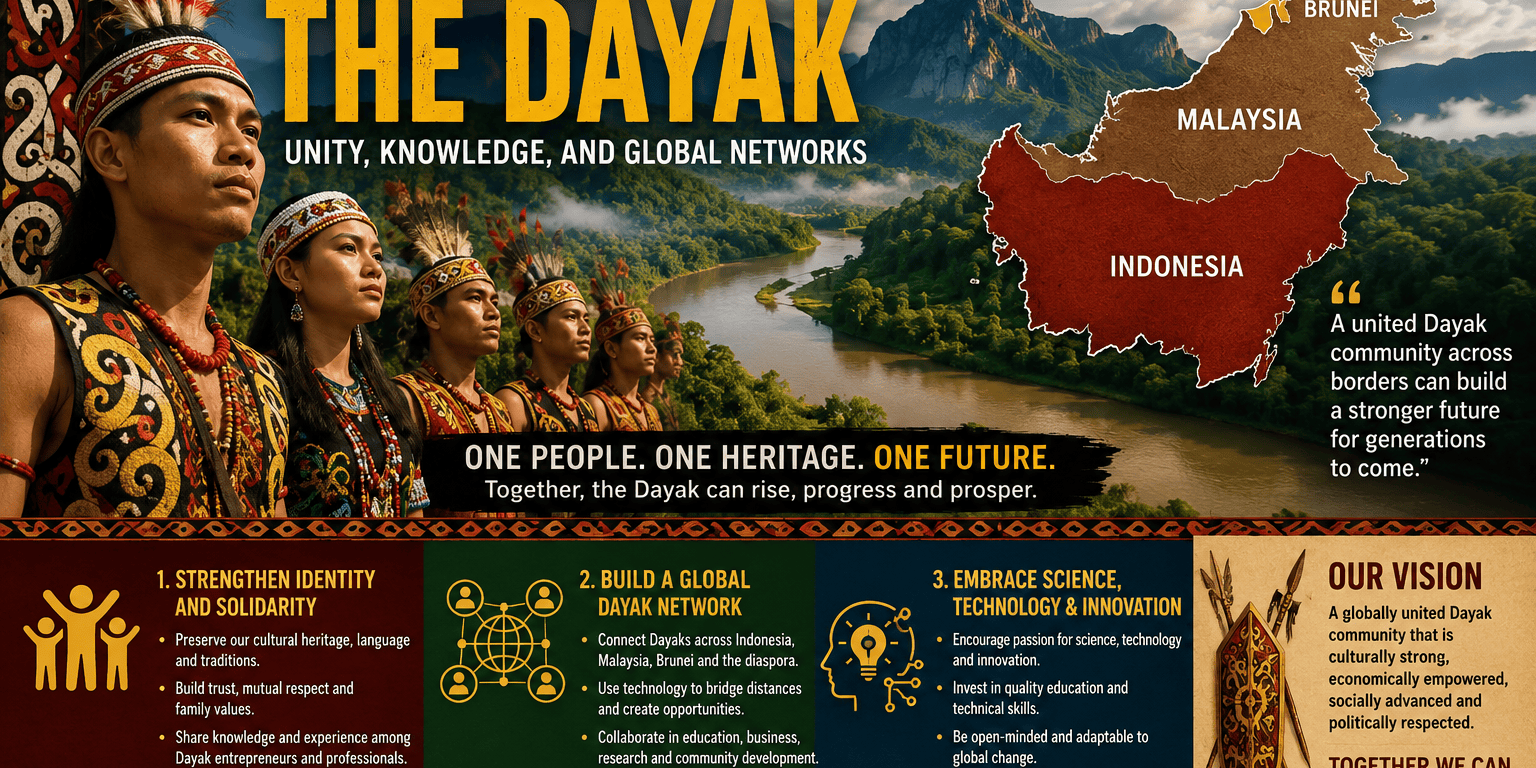
The indigenous peoples of the Heart of Borneo are collectively known as the Dayak. They represent one of the largest indigenous populations on the island of Borneo. Despite their significant numbers and shared cultural heritage, the Dayak remain politically and geographically divided across three sovereign states: Indonesia, Malaysia, and Brunei.
This fragmentation has limited opportunities for coordinated economic development, social advancement, and political cooperation. To strengthen the future of the Dayak community, there is a need to explore strategies that can enhance their economic capacity, social welfare, and political influence while building upon their shared history, culture, and aspirations.
Learning from the Concept of the Global Tribe
In his book Tribes: How Race, Religion and Family Determine Success in the New Global Economy, Joel Kotkin argues that some communities have achieved remarkable global success by functioning as “global tribes.” He cites examples such as the Jewish, British, Japanese, Chinese, and Indian communities.
According to Kotkin, successful global tribes possess two important characteristics:
- A strong sense of common identity and shared values.
- A willingness to embrace scientific progress, innovation, and technological advancement.
Rather than abandoning their traditions, these communities preserve their cultural identity while adapting to the demands of an increasingly interconnected and knowledge-driven world.
Strengthening Dayak Identity and Solidarity
The Dayak community can benefit from strengthening its shared ethnic identity while cultivating a greater sense of mutual support and collective responsibility.
Although separated by national borders, the Dayak share common historical experiences, cultural traditions, indigenous values, and ancestral heritage. These commonalities provide a strong foundation for deeper cooperation.
Greater unity would encourage successful Dayak professionals, entrepreneurs, academics, and community leaders to mentor younger generations by sharing their knowledge, experience, and resources. Such collaboration could accelerate economic development, educational achievement, and leadership within the wider Dayak community.
When people share a common identity and trust one another, they are often more willing to invest in each other’s success.
Building a Global Dayak Network
In today’s digital age, geographical distance is no longer the barrier it once was.
A global Dayak network could connect individuals, organisations, businesses, researchers, students, and community leaders across Indonesia, Malaysia, Brunei, and the wider international diaspora.
Such a network could facilitate:
- Professional networking
- Educational collaboration
- Business partnerships
- Cultural preservation
- Research initiatives
- Leadership development
- Community assistance
Digital platforms, social media, online forums, and educational exchanges can strengthen communication and create opportunities that transcend political boundaries.
A connected community is better positioned to respond collectively to economic challenges and emerging global opportunities.
Investing in Science, Technology, and Innovation
Long-term progress also depends on investing in education, science, and technology.
The younger generation should be encouraged to pursue careers in engineering, information technology, artificial intelligence, medicine, biotechnology, environmental science, and entrepreneurship. Technical knowledge and innovation will increasingly determine competitiveness in the global economy.
Parents, educators, and community leaders all have important roles in nurturing curiosity, creativity, and lifelong learning among Dayak youth.
By embracing scientific advancement while preserving their cultural identity, the Dayak can participate confidently in the knowledge economy without losing their unique heritage.
A Vision for the Future
Economic prosperity, social development, and stronger political participation are long-term goals that require cooperation, education, and visionary leadership.
Building stronger relationships across borders does not require abandoning national identities. Rather, it means fostering voluntary cooperation based on shared heritage, mutual respect, and common aspirations.
A globally connected Dayak community can create greater opportunities for future generations through education, entrepreneurship, cultural preservation, and professional collaboration.
Conclusion
The future of the Dayak depends not only on preserving their rich cultural heritage but also on embracing innovation, education, and global cooperation.
By strengthening solidarity, building international networks, and investing in science and technology, the Dayak community can enhance its economic opportunities, social well-being, and leadership capacity while remaining proud of its indigenous identity.
The responsibility now lies with community leaders, educators, professionals, entrepreneurs, and young people themselves to work together toward a future built on unity, knowledge, and shared progress.
 Indie Borneo