

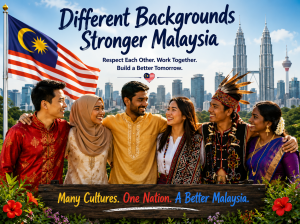
Malaysia’s greatest strength has always been its diversity. Malays, Chinese, Indians, Dayaks, Kadazans, Orang Asli, and many other communities have each contributed to building the nation we know today. Yet from time to time, racial rhetoric resurfaces, threatening to divide people who have lived, worked, and prospered together for generations.
Rather than asking which race contributes the most, perhaps we should ask a more meaningful question: What values help individuals and communities succeed?
Success Is Built, Not Given
Across every community, successful people often share similar characteristics. They value education, work hard, manage their finances wisely, adapt to changing circumstances, and are willing to take calculated risks. These qualities are not inherited through ethnicity—they are learned through family, culture, discipline, and personal effort.
Many Chinese Malaysian families have earned a reputation for entrepreneurship and business acumen. Likewise, Malays have excelled in public service, education, and business, while Indians have made remarkable contributions in medicine, law, engineering, academia, and entrepreneurship. Indigenous communities, including the Dayaks and Kadazans, have contributed significantly in public administration, natural resource management, education, and the preservation of Malaysia’s rich cultural heritage.
No single community has a monopoly on talent, determination, or innovation.
The Danger of Racial Politics
History shows that when politicians appeal to fear and ethnic division, society becomes distracted from the real issues that affect people’s lives—economic opportunities, education, healthcare, infrastructure, governance, and the cost of living.
Blaming one community for another’s challenges rarely solves problems. Instead, it creates distrust and weakens national unity.
Malaysia’s future depends on leaders who unite rather than divide, focusing on policies that improve the lives of all citizens regardless of race or religion.
The Economy Thrives Through Cooperation
Malaysia’s economy has grown because people from different backgrounds have worked together. Entrepreneurs create businesses, workers contribute their skills, professionals provide expertise, and consumers support one another’s livelihoods.
Calls to boycott businesses solely because of the owner’s ethnicity can have unintended consequences. Businesses employ people from many backgrounds, purchase from local suppliers, and contribute taxes that fund public services. When businesses suffer, employees, families, and communities often feel the impact regardless of race.
A stronger economy is built on confidence, investment, innovation, and cooperation—not division.
Learning From One Another
Every culture has values worth appreciating.
Some families place a strong emphasis on education. Others highlight community service, resilience, discipline, hospitality, or entrepreneurship. Instead of viewing these differences as barriers, Malaysians can learn from one another and adopt the best practices that help individuals and society flourish.
Success is not about becoming like another community. It is about embracing values that encourage lifelong learning, integrity, hard work, and responsibility.
A Shared Future
Malaysia’s greatest opportunities lie ahead if its people choose collaboration over confrontation.
The nation does not need more racial suspicion. It needs better schools, stronger institutions, more quality jobs, transparent governance, thriving businesses, and equal opportunities for every citizen to realise their potential.
The measure of a nation’s success is not which community wins, but whether every community has the opportunity to succeed.
If Malaysians focus on shared values instead of shared divisions, the country will become stronger, more competitive, and more united for generations to come.
Source : Dr Chan Lui Lee
 Indie Borneo