
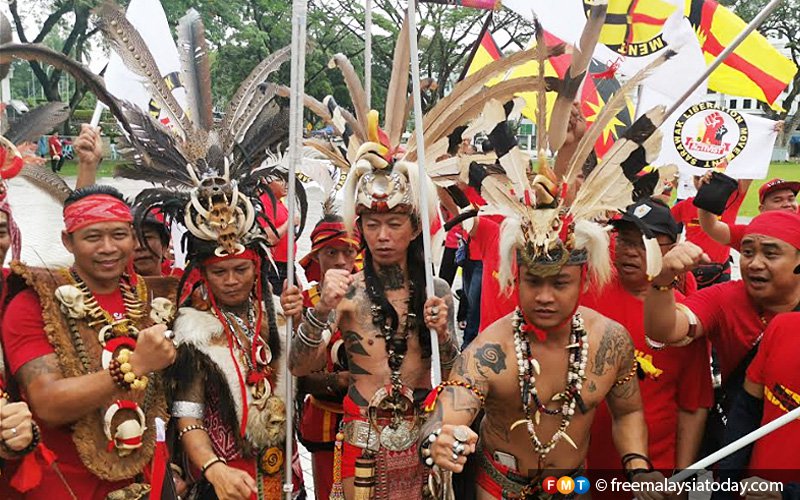
For decades, political discussions surrounding the Dayak community in Sarawak have been shaped by deep emotions, historical grievances, and fears about cultural survival. One viral political text circulating online claims that Dayaks — especially the Iban community — have been systematically divided, marginalized, and economically weakened by political elites in Malaysia.
The document reflects anger, frustration, and distrust toward former political leaders such as Abdul Taib Mahmud and Mahathir Mohamad. It accuses them of engineering divisions among Dayaks, limiting economic opportunities, suppressing indigenous rights, and weakening Dayak political influence.
While many of the claims remain politically contested and would require historical verification, the document itself is important because it reveals the emotional and political sentiments felt by segments of the Dayak population.
A History of Dayak Political Fragmentation
The article argues that one of the biggest weaknesses of the Dayak community has been internal division. It references the fragmentation of political parties such as the Parti Bansa Dayak Sarawak (PBDS) and Sarawak National Party (SNAP), suggesting that political rivalries weakened collective Dayak influence.
The narrative claims that external political forces benefited whenever Dayaks were split into competing factions. According to the text, unity among the Iban, Bidayuh, and Orang Ulu communities was viewed as a political threat because a united Dayak bloc could become a decisive force in Sarawak politics.
Whether entirely accurate or not, the argument reflects a broader historical reality: indigenous politics in Sarawak has often struggled with fragmentation, personality conflicts, and regional divisions.
Economic Marginalization and Land Issues
One of the strongest themes in the document is the issue of Native Customary Rights (NCR) land. The article accuses political and corporate elites of exploiting Dayak land through logging concessions, hydroelectric dam projects, and delayed land title recognition.
For many Dayaks, land is more than property — it represents identity, ancestry, and survival. Development projects involving logging and dams have long created tensions between modernization and indigenous rights in Sarawak.
The text repeatedly warns that losing NCR land would mean losing the foundation of Dayak existence itself. This fear is not unique to Sarawak; indigenous communities worldwide often see land rights as central to cultural preservation.
Education, Representation, and Opportunity
Another major accusation in the article is that Dayaks were intentionally prevented from gaining higher educational and economic power. The text claims that Dayak students were discouraged from entering prestigious fields such as law, engineering, medicine, and political science.
It also argues that Dayaks were underrepresented in government positions, corporate leadership, and national institutions. According to the document, this created long-term economic dependency and limited political influence.
These concerns connect to broader debates in Malaysia regarding affirmative action, regional inequality, and the distribution of economic development between Peninsular Malaysia and East Malaysia.
Religion and Cultural Identity
The article strongly emphasizes concerns about cultural and religious erosion. It mentions the decline of Iban language usage in official institutions, the destruction of traditional literature, and fears of forced cultural assimilation.
Christianity is portrayed in the text as a pillar of Dayak identity, while the spread of Islamic influence is framed as part of a political strategy. These claims are controversial and sensitive, but they illustrate the anxieties many indigenous groups experience when facing rapid social and political change.
At its core, the document expresses fear that modernization and centralized political power may erase traditional Dayak identity over time.
The Rise of Digital Resistance
Interestingly, the article also highlights the growing role of bloggers and digital communication in spreading political awareness among Dayaks. It claims that the internet became a powerful tool to challenge political narratives and expose alleged injustices.
This reflects a broader global trend: marginalized communities increasingly use digital platforms to organize, preserve identity, and challenge dominant political systems.
In Sarawak today, social media has become a major space for discussions about indigenous rights, autonomy, cultural preservation, and political reform.
Separating Emotion from Historical Reality
It is important to approach documents like this critically. The text contains sweeping accusations, emotionally charged language, and claims that are difficult to independently verify. Some statements may reflect political opinion rather than documented historical fact.
However, dismissing the document entirely would also ignore the deeper issues it reveals:
- Feelings of political exclusion
- Anxiety over land rights
- Fear of cultural erosion
- Distrust toward centralized power
- Frustration over economic inequality
These concerns continue to shape political conversations in Sarawak today.
Conclusion
The viral Dayak political text is more than just a controversial manifesto. It is a reflection of historical trauma, political frustration, and the struggle for identity among indigenous communities in Sarawak.
Whether one agrees with its claims or not, the document highlights an important reality: communities that feel unheard will continue searching for ways to preserve their culture, rights, and political voice.
The future of Sarawak may ultimately depend not on division, but on building a political environment where indigenous communities feel genuinely represented, respected, and included in the state’s development.
Source : https://www.e-pbk.com/
 Indie Borneo