
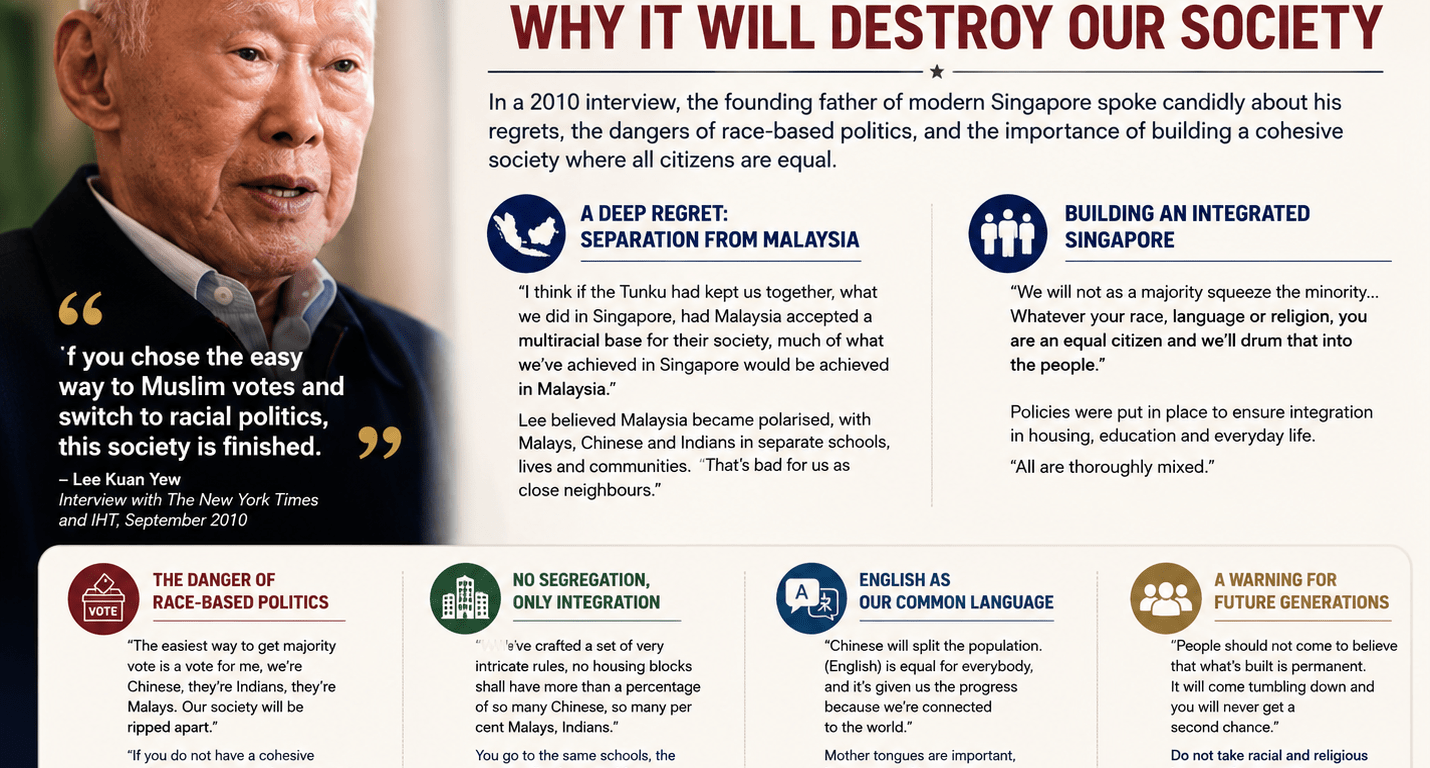
In today’s increasingly divided political climate, the words of Lee Kuan Yew remain highly relevant. Long regarded as one of Asia’s most influential leaders, the founding father of Singapore once gave a powerful reflection on race, politics, and national unity during a 2010 interview with The New York Times and the International Herald Tribune.
His message was simple yet profound: when politicians play the race card for political gain, society itself begins to fracture.
A Regret That Never Left Him
One of Lee’s greatest regrets was Singapore’s separation from Malaysia in 1965. He believed that if Malaysia had embraced a truly multiracial foundation, both nations could have developed stronger racial harmony and broader economic progress together.
According to Lee, the separation deeply affected him because he envisioned a united society where people of different races could coexist as equal citizens rather than competing groups divided by identity politics.
He observed that Malaysia gradually became more polarised, with communities often separated through different school systems, languages, and social environments. This separation, he believed, weakened national cohesion and mutual understanding.
Building a Multiracial Society
After Singapore became independent, Lee and his colleagues consciously chose a different path. They rejected the idea that a majority race should dominate minorities.
As Lee explained:
“We will not as a majority squeeze the minority.”
The government worked to ensure that every citizen, regardless of race, language, or religion, would be treated equally under the law.
Singapore introduced policies designed to prevent racial segregation. Housing areas were carefully balanced to ensure that Chinese, Malays, Indians, and others lived side by side. Schools, workplaces, shopping areas, and public spaces became places where communities interacted daily.
Lee believed integration was not something that happened naturally. It required deliberate planning and continuous effort.
The Danger of Race-Based Politics
Perhaps the most striking part of Lee’s interview was his warning about politicians exploiting racial identity to gain support.
He said:
“If you chose the easy way to Muslim votes and switch to racial politics, this society is finished.”
Lee understood that appealing to ethnic emotions is one of the easiest ways to gain political support. However, he also believed it was one of the fastest ways to destroy trust between communities.
When politics becomes centred on race instead of national interest, people begin to see each other as rivals rather than fellow citizens. Fear, suspicion, and resentment slowly replace unity.
According to Lee, a divided society cannot achieve long-term progress because energy becomes wasted on racial competition rather than national development.
Why English Became Singapore’s Working Language
Another important decision made by Singapore’s leadership was adopting English as the country’s working language.
Lee explained that making Chinese the dominant language would divide the population further. English, meanwhile, acted as a neutral language that belonged equally to everyone while connecting Singapore to the global economy.
At the same time, mother tongues such as Malay, Mandarin, and Tamil were preserved as second languages to maintain cultural identity.
This balance between unity and diversity became one of Singapore’s defining strengths.
Lessons for Modern Societies
Lee Kuan Yew repeatedly warned that harmony should never be taken for granted. Younger generations, he believed, often assume peace and stability are permanent conditions. In reality, social cohesion is fragile and can quickly collapse if leaders manipulate racial or religious issues for short-term political gain.
His observations continue to resonate not only in Singapore and Malaysia, but across many multiracial societies around the world.
The lesson is clear: nations become stronger when citizens see themselves first as members of a shared society rather than separate racial or ethnic groups. Leadership that promotes unity, equal opportunity, and mutual respect creates long-term stability, while politics built on division ultimately weakens the nation itself.
More than a decade after that interview, Lee’s warning still serves as a reminder that the future of any multicultural society depends on its ability to rise above race-based politics and build a common national identity.
Source : https://says.com/ by Sadho Ram
 Indie Borneo